PRESS RELEASE · Youth support / AI Mentor

Four in five young people with money worries chose a next step after AI consultation

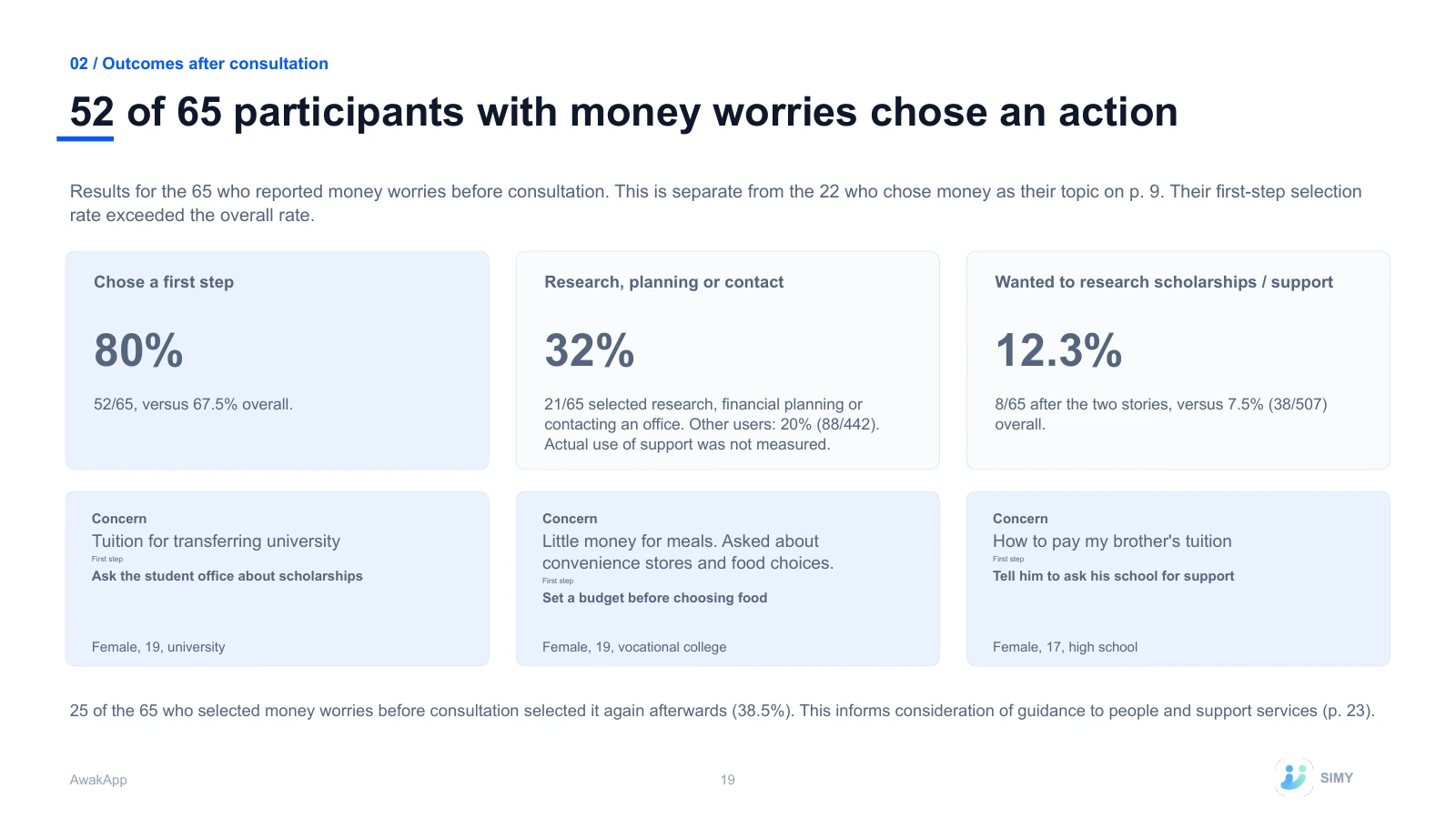
AwakApp reports that 52 of 65 participants with concerns about tuition, living costs or household finances chose an action. Findings and consultation design from the 507-person youth pilot are now available in Japanese and English.

On 5 October 2026, AwakApp, a general incorporated association in Japan, published the findings and consultation design of its AI Mentor youth project in Japanese and English. Of 65 participants who reported worries about tuition, living costs or household finances before consultation, 52—four in five—selected a first action for that day afterwards.

The pilot involved 507 AI Mentor users aged 15–19 across all 47 prefectures of Japan. Across the full group, 342—approximately two in three—selected an action such as researching, studying or talking to someone. Supported by Water Dragon Foundation, the pilot ran from 1 to 10 August 2026.

These counts are self-reports from the immediate post-consultation questionnaire, not verified completed actions or effects attributable solely to AI. The 65 participants reported money worries; they were not classified as a low-income group.

From tuition concerns to asking student affairs about scholarships

One participant described the consultation topic as “tuition for transferring to another institution” and their first action for the day as “asking student affairs about scholarships.” These are translations of an anonymous post-consultation response already included in the published project report.

For someone worried about tuition, identifying whom to ask and what to discuss is a potential next step. AI Mentor is a chat consultation service designed to help young people organize their concerns and choose something to work on. The project aimed to reach young people whose access to consultation and learning opportunities may be limited by their household’s financial circumstances.

Users choose their priorities, then make the plan concrete enough for five minutes today

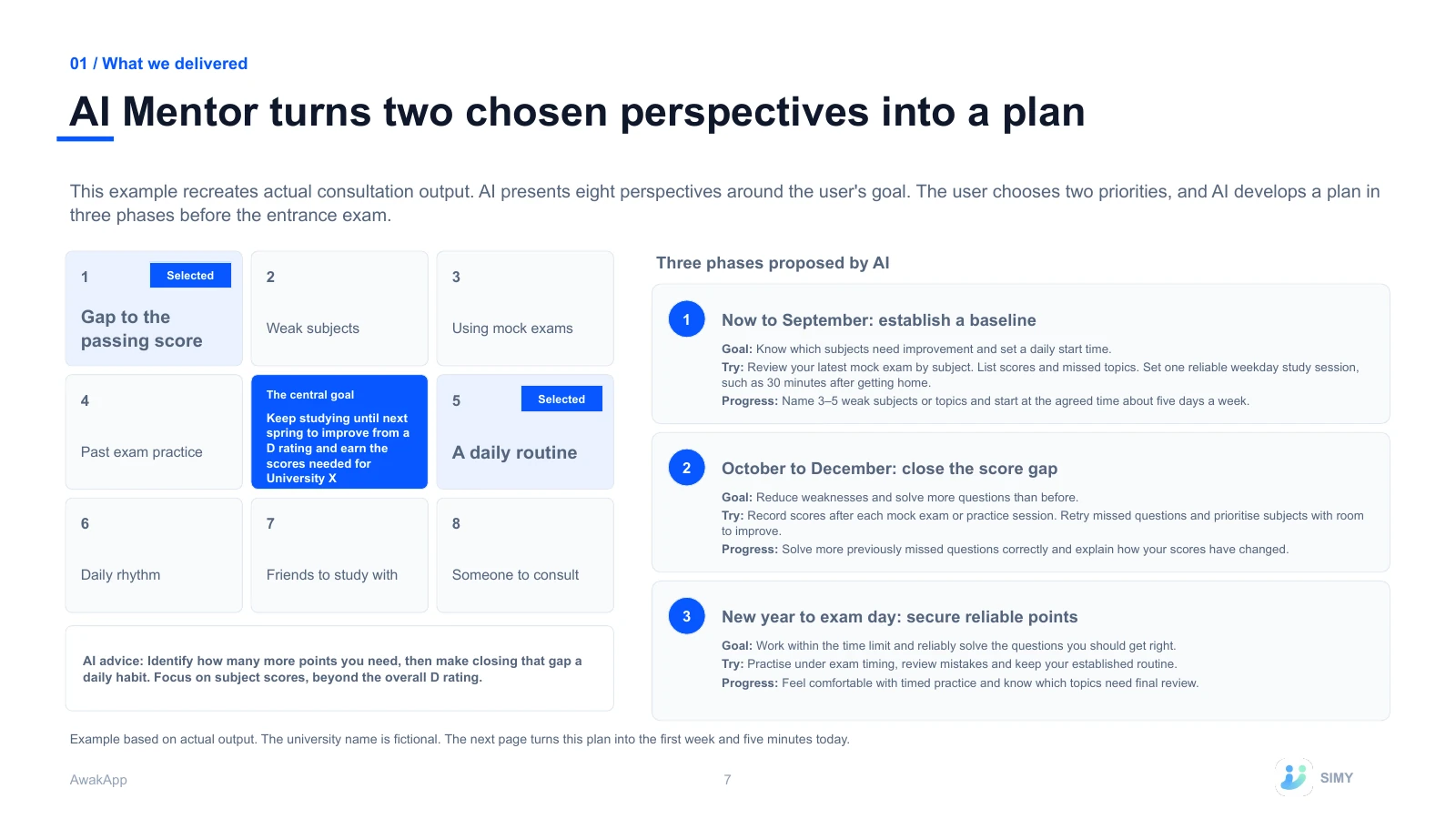
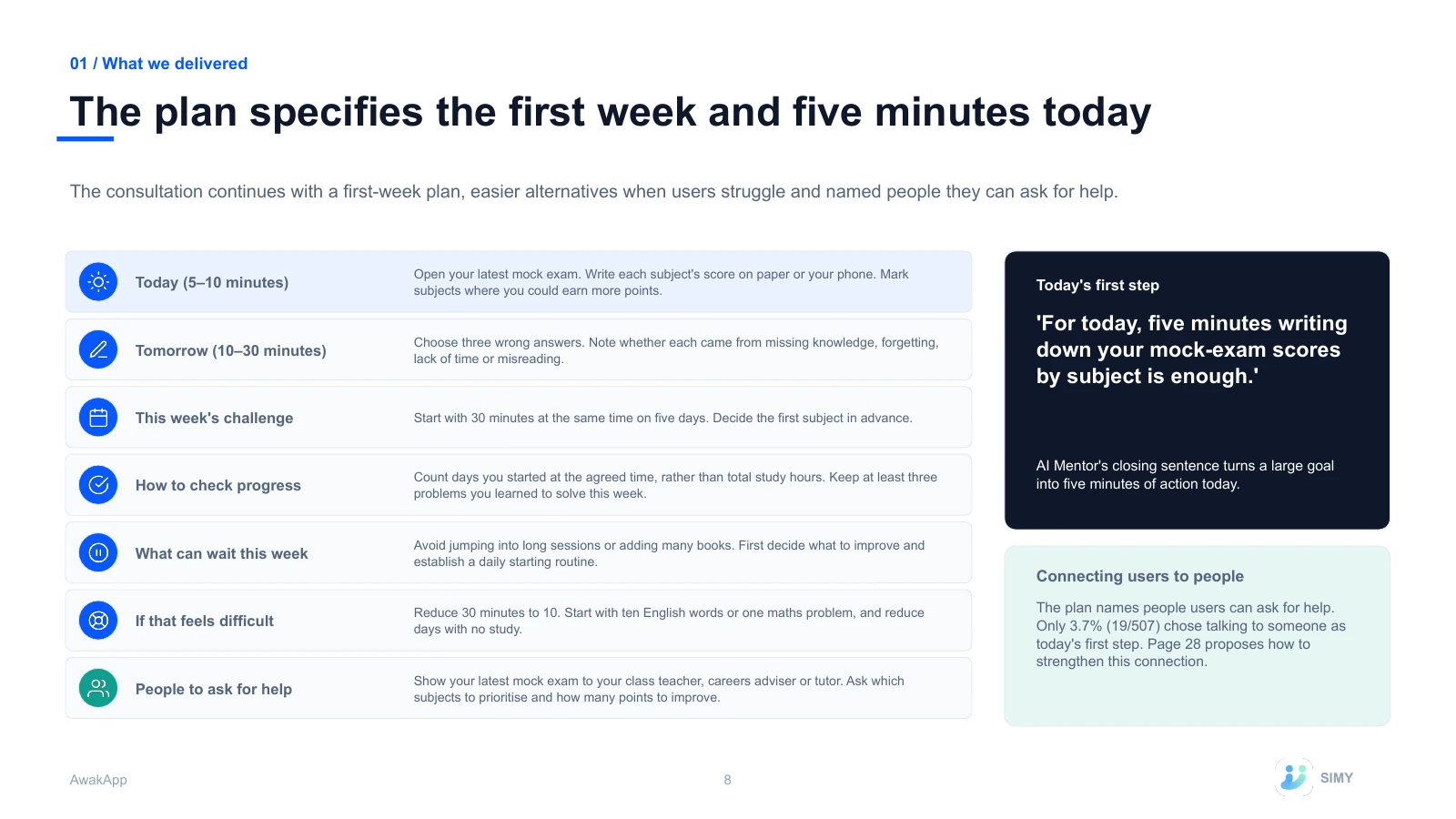
The AI presents eight perspectives based on the consultation, and users select two that matter to them. It then develops a staged plan, a first-week plan and something they can do in five to ten minutes that day. This sequence is the consultation design used in AI Mentor.

In the published university-admissions example, the user selects the gap to the required score and a daily routine. The suggested action for that day is to write down mock-exam scores by subject. The example also offers shorter sessions if the plan feels difficult and suggests consulting a homeroom or career-guidance teacher.

This screen example was constructed from actual AI output to explain the design. It is separate from the participant response above and does not show actions that a participant carried out.

Also examining access to learning materials and study conditions at home

The pilot also examined nine household learning and daily-life resources, including learning materials, a study desk and extracurricular costs. In the group reporting fewer resources, 108 of 158 selected an action. This is not an income classification and is a different grouping from the 65 participants with money worries in the headline.

Some participants did not describe their consultation concretely. Future questions include which prompts make concerns easier to organize, whether users carry out their chosen steps, and whether they connect with people or support services. The published report presents both findings and remaining questions.

From AI Mentor to SIMY

AI Mentor has now evolved into SIMY. SIMY’s official website presents the current product as an AI service that uses conversations to organize ways of working and support execution.

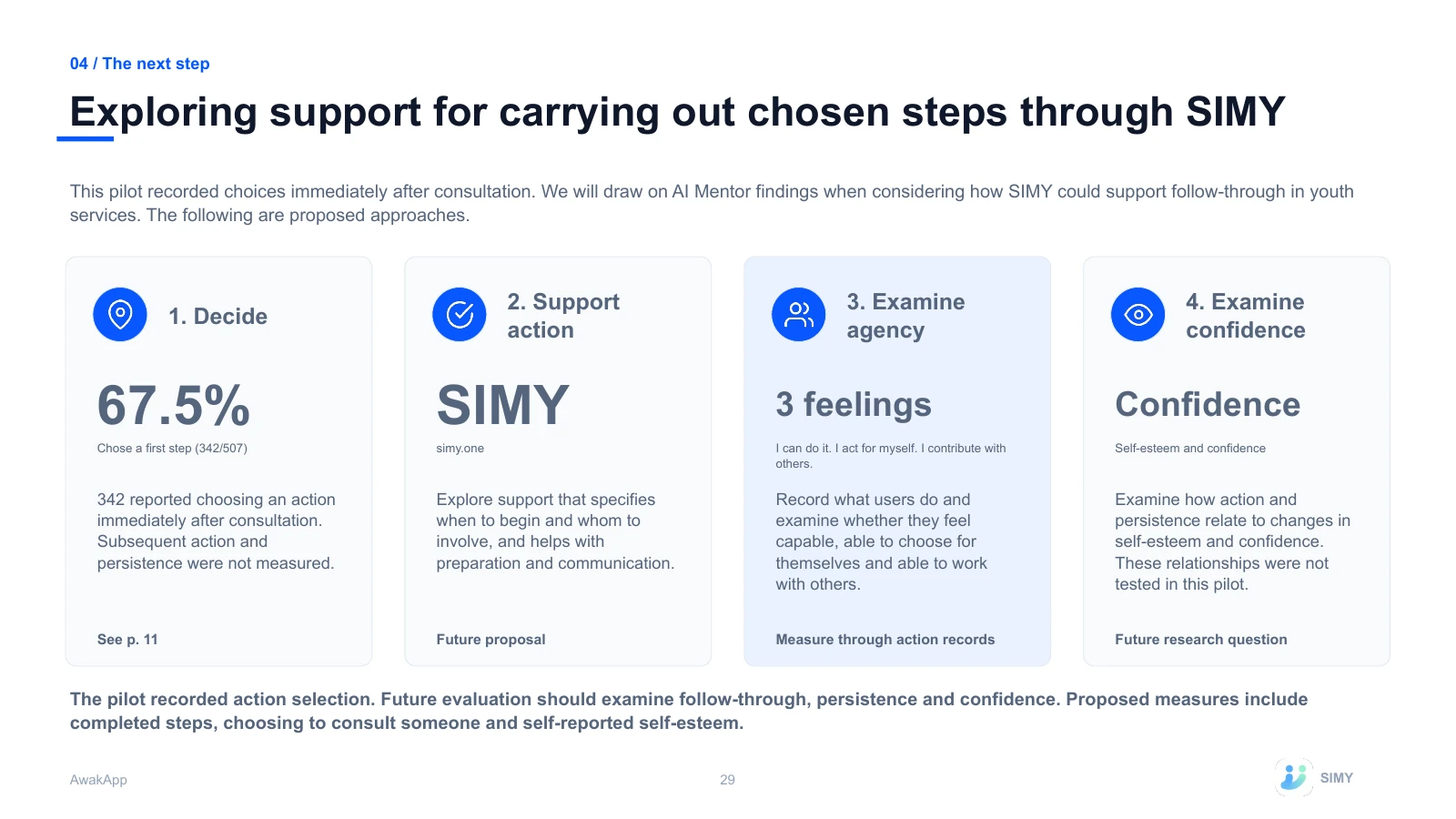
For youth support, the consultation design and pilot findings will inform proposed support for carrying out chosen steps. Guidance on scholarships and support services, and assistance with following through, are future approaches.

AwakApp, the general incorporated association, led the project. AwakApp Japan LLC issues this announcement and handles media inquiries.

View detailed results

Participants with money worries

The subgroup consists of 65 participants selecting worries about tuition, living costs or household finances in pre-consultation question SC6. Of these, 52 selected an action category (options 1–9) in post-consultation question Q4. This subgroup is included in the full sample of 507.

Other immediate responses

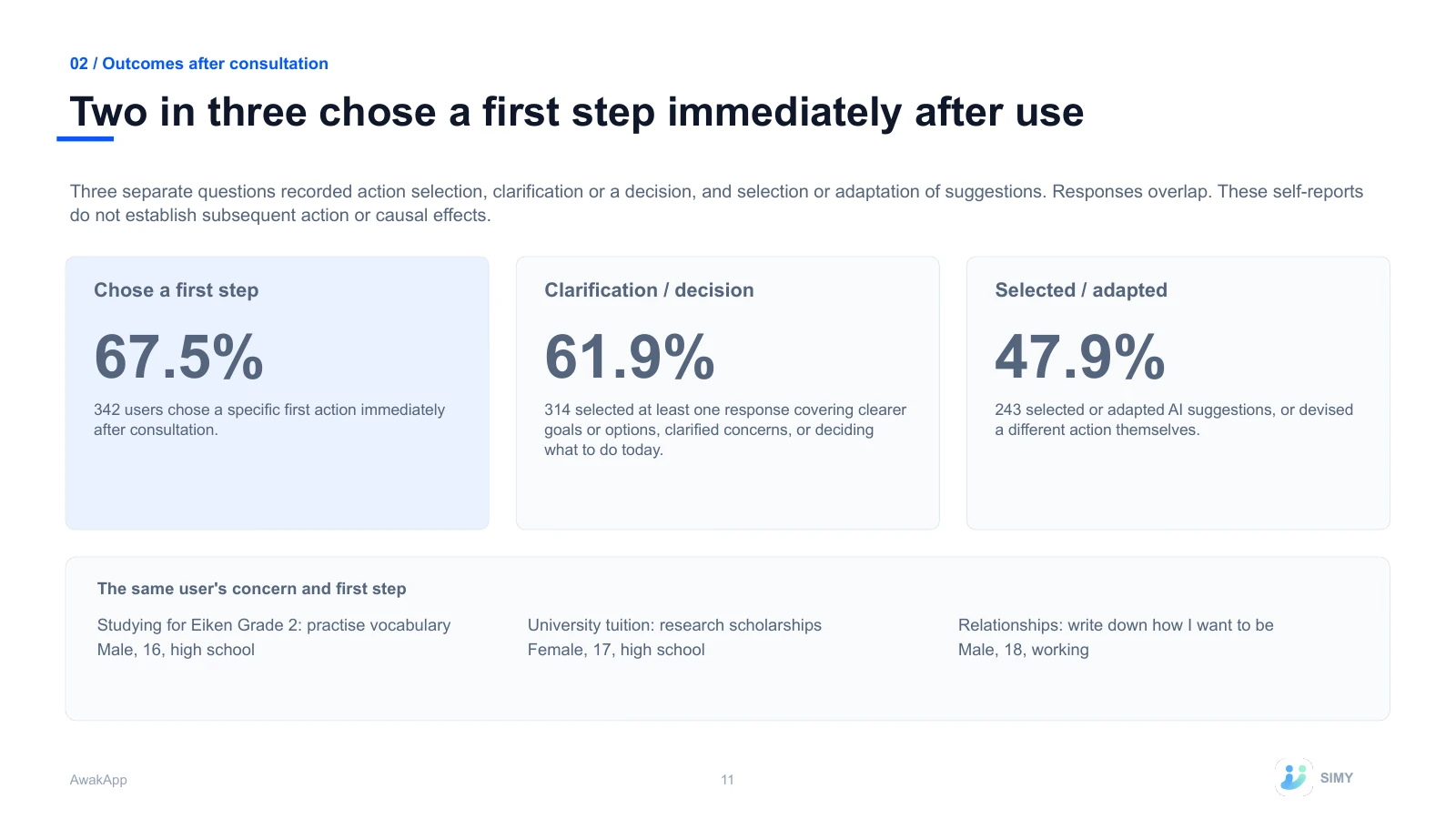
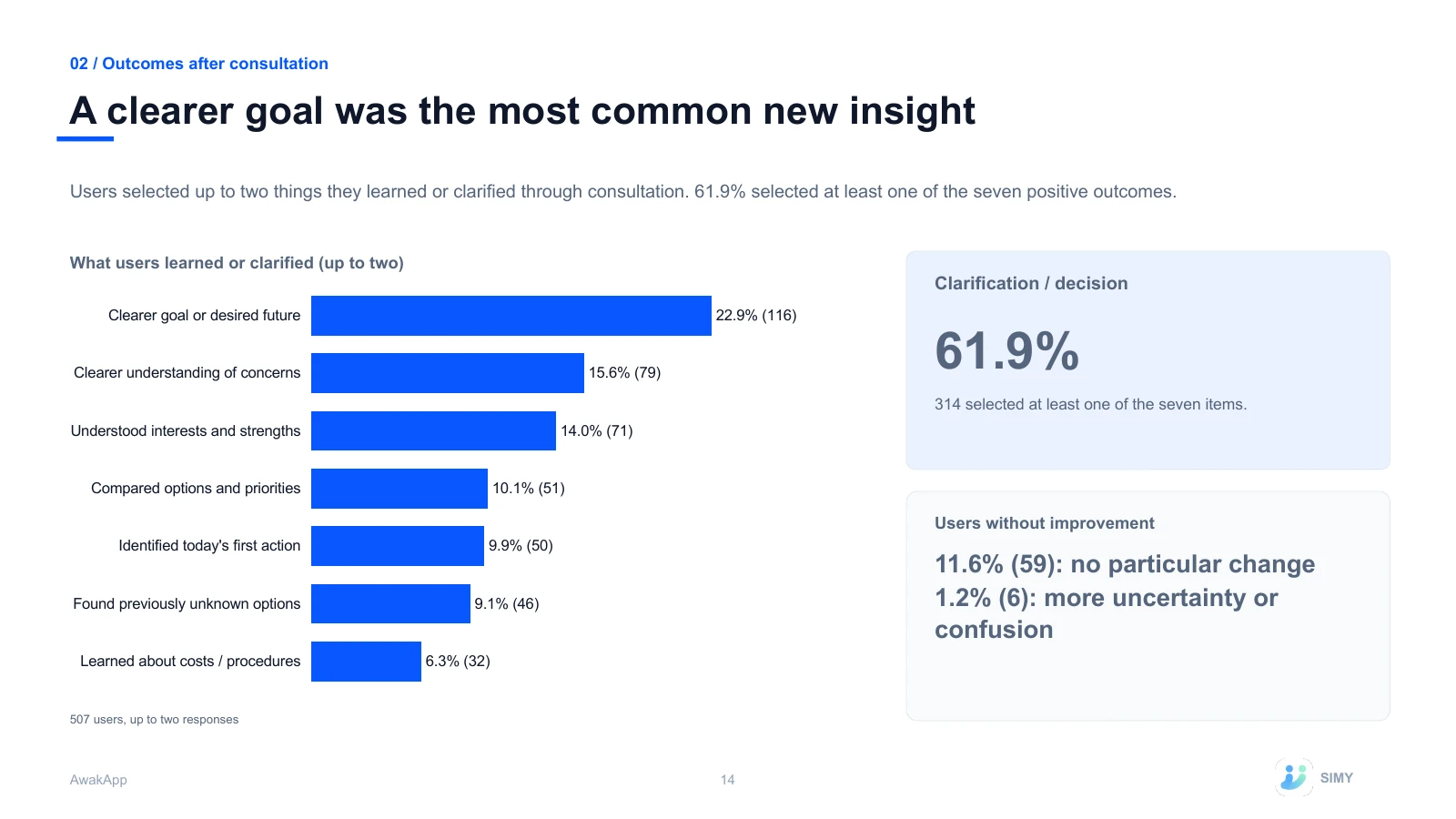
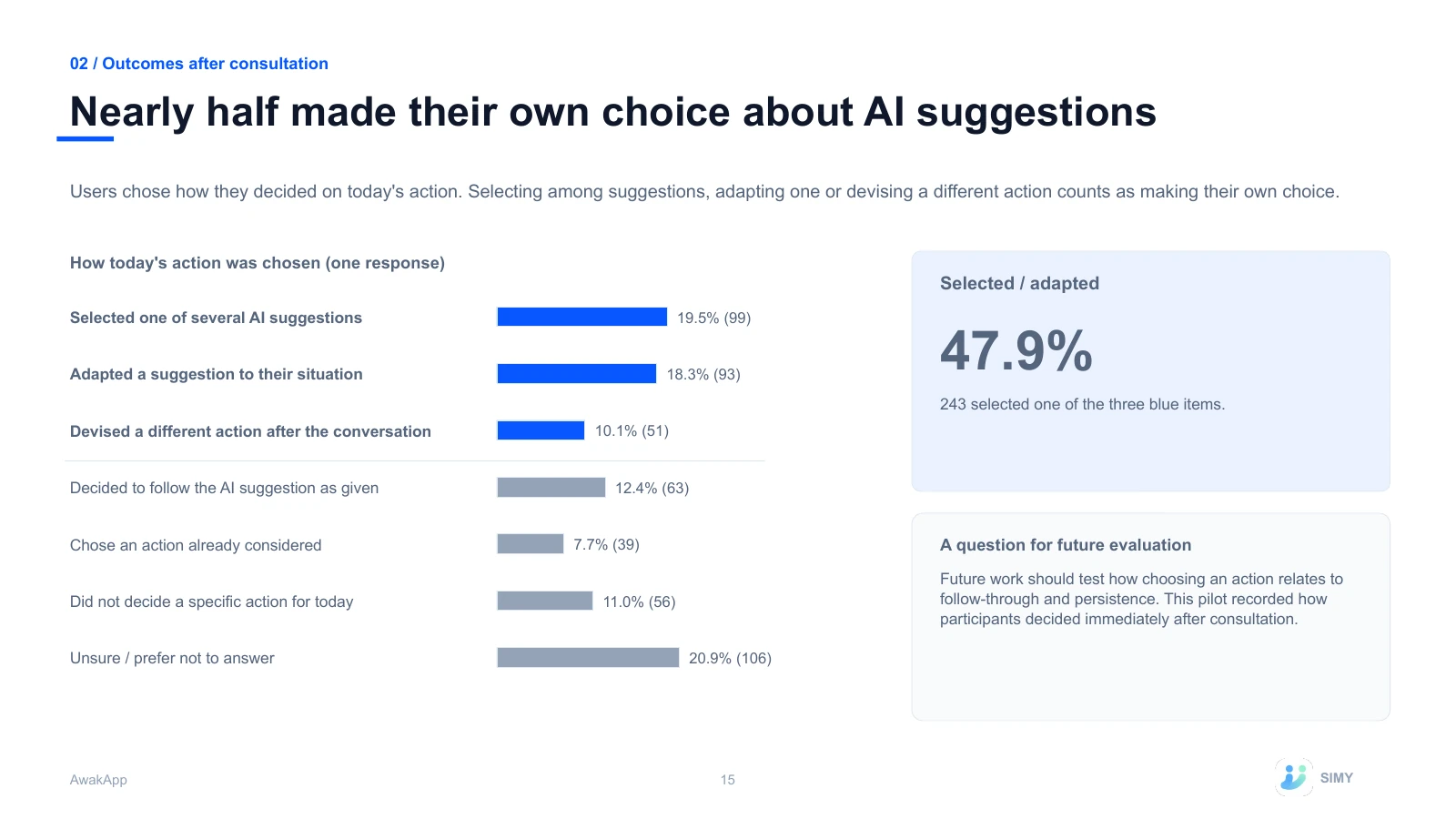
314 participants selected at least one of seven responses covering clearer goals, new options, understanding information, clarification of concerns or deciding today’s action. In a separate question, 243 reported selecting among suggestions, adapting a suggestion or devising another action.

Household comparisons

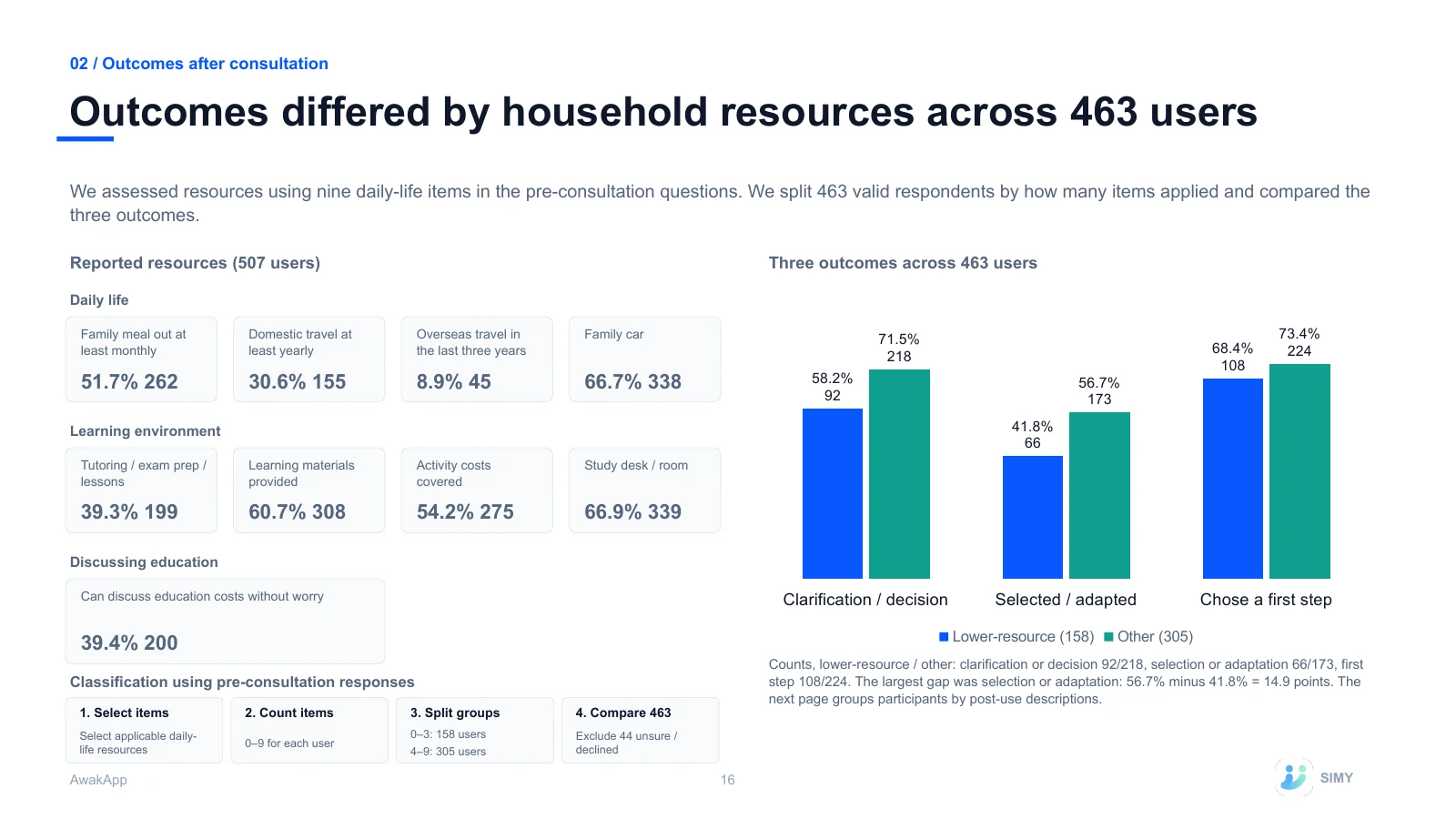
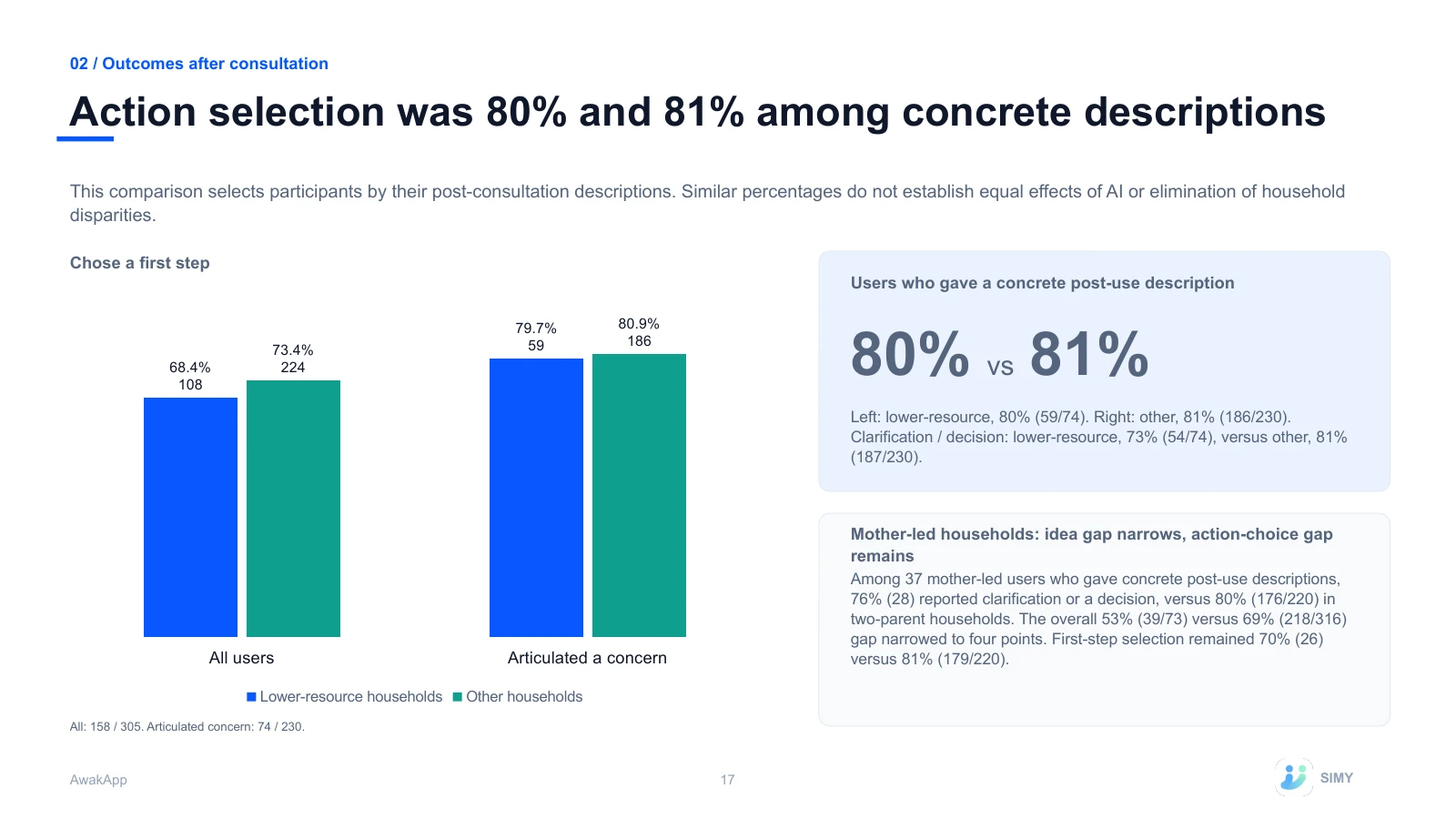
Excluding 44 unsure or declined responses, 463 participants were classified: 158 reported 0–3 of nine resources, and 305 reported 4–9. Respectively, 108 (68.4%) and 224 (73.4%) selected an action.

Post-consultation descriptions

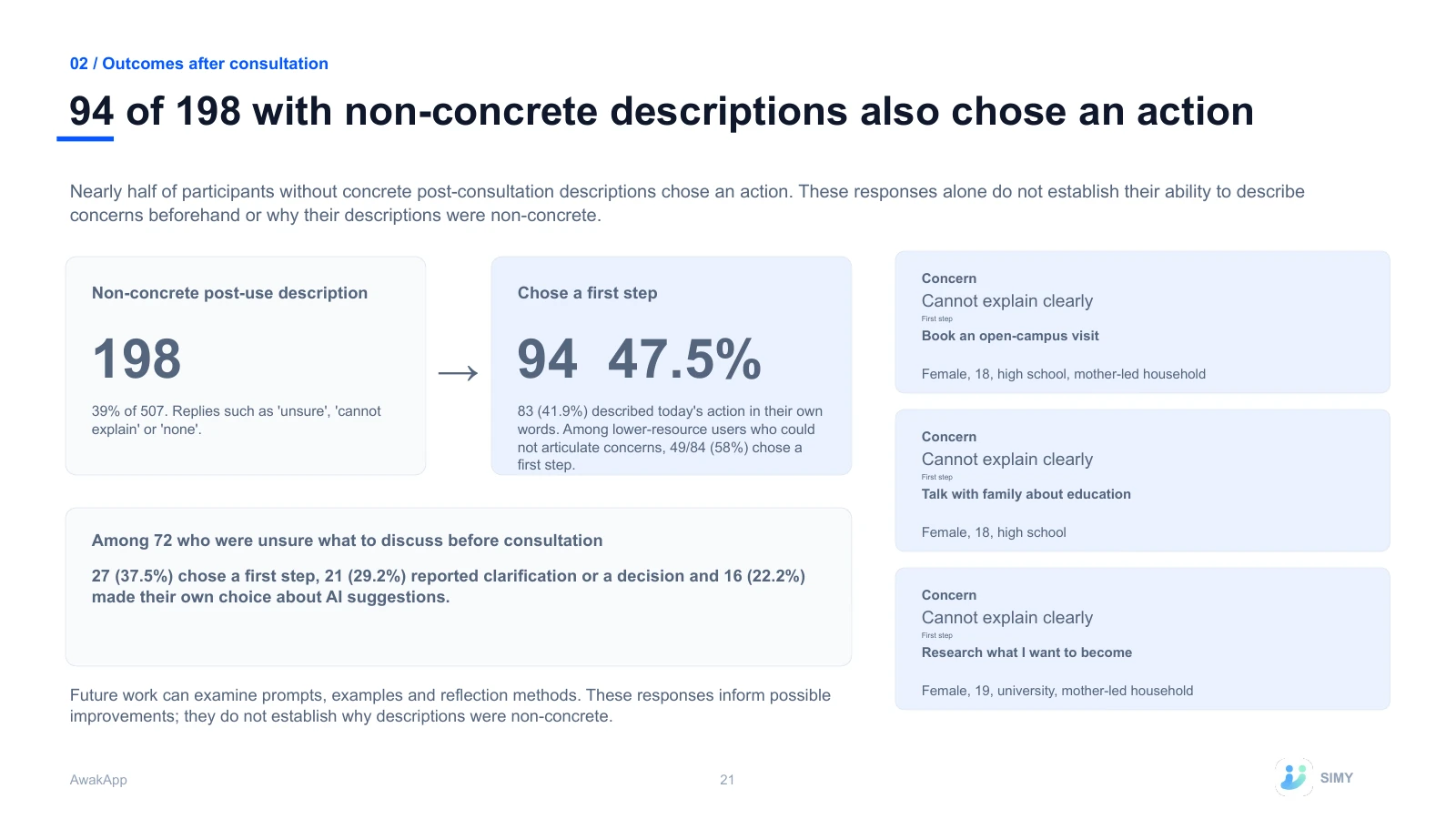
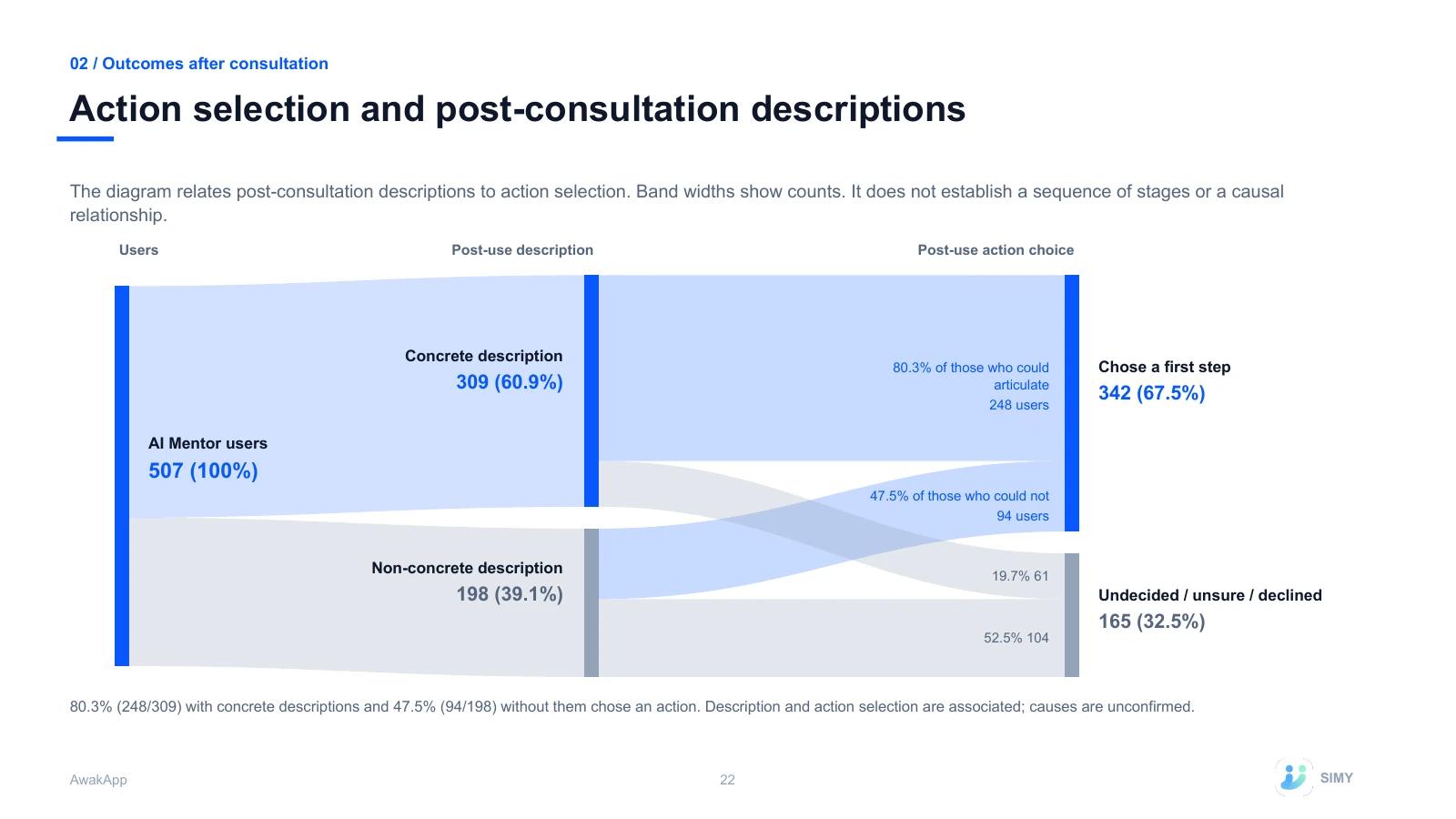
Among those giving concrete descriptions of their consultation, 59/74 and 186/230 selected an action. Those without concrete descriptions numbered 84/158 and 75/305. These figures do not measure pre-consultation ability or establish the reasons for the responses.

FOR REPORTERS

Resources for reporting

What is being published?

On 5 October 2026, AwakApp published findings from 507 AI consultation users, household comparisons and the consultation process in Japanese and English. Each report has 30 slides, with PDF and text access.

Who does “four in five” refer to?

It refers to the subgroup of 65 participants who reported money worries before consultation; 52 selected an action category afterwards. The full-sample figure is 342/507. These figures are not population estimates for all young people.

How does the consultation differ from a general AI chat?

The project used a defined sequence: users choose two of eight perspectives, then work through a staged plan toward something they can do in five to ten minutes that day. No comparative trial against other services was conducted.

Can the consultation process be viewed?

Slides 7 and 8 show a screen example constructed from actual AI output, using university admissions to illustrate the process. It is not a participant chat log or an interactive demo.

Were subsequent actions or reduced economic disparities verified?

The main figures describe immediate self-reported choices. Subsequent execution, persistence and reduced economic disparities were not verified. Post-consultation states must be distinguished from changes measured before and after use.

Where can I find information about SIMY today?

SIMY’s official website describes current product features and plans. The youth pilot and the current product information should be read separately. Contact the media desk on this page about applications to youth support.

PROJECT REPORT

Project report slides

30 slides · English

Publication edition revised on 5 October 2026 from the project report dated 25 August 2026. Figures are retained and interpretations clarified. Enlarge a slide and use the arrows to browse.

Download the report PDF (30 slides)

The method section explains the questions, denominators and scope of the findings.

01 / 30

AI Mentor findings and future work

Enlarge ↗
Read slide 1 as text
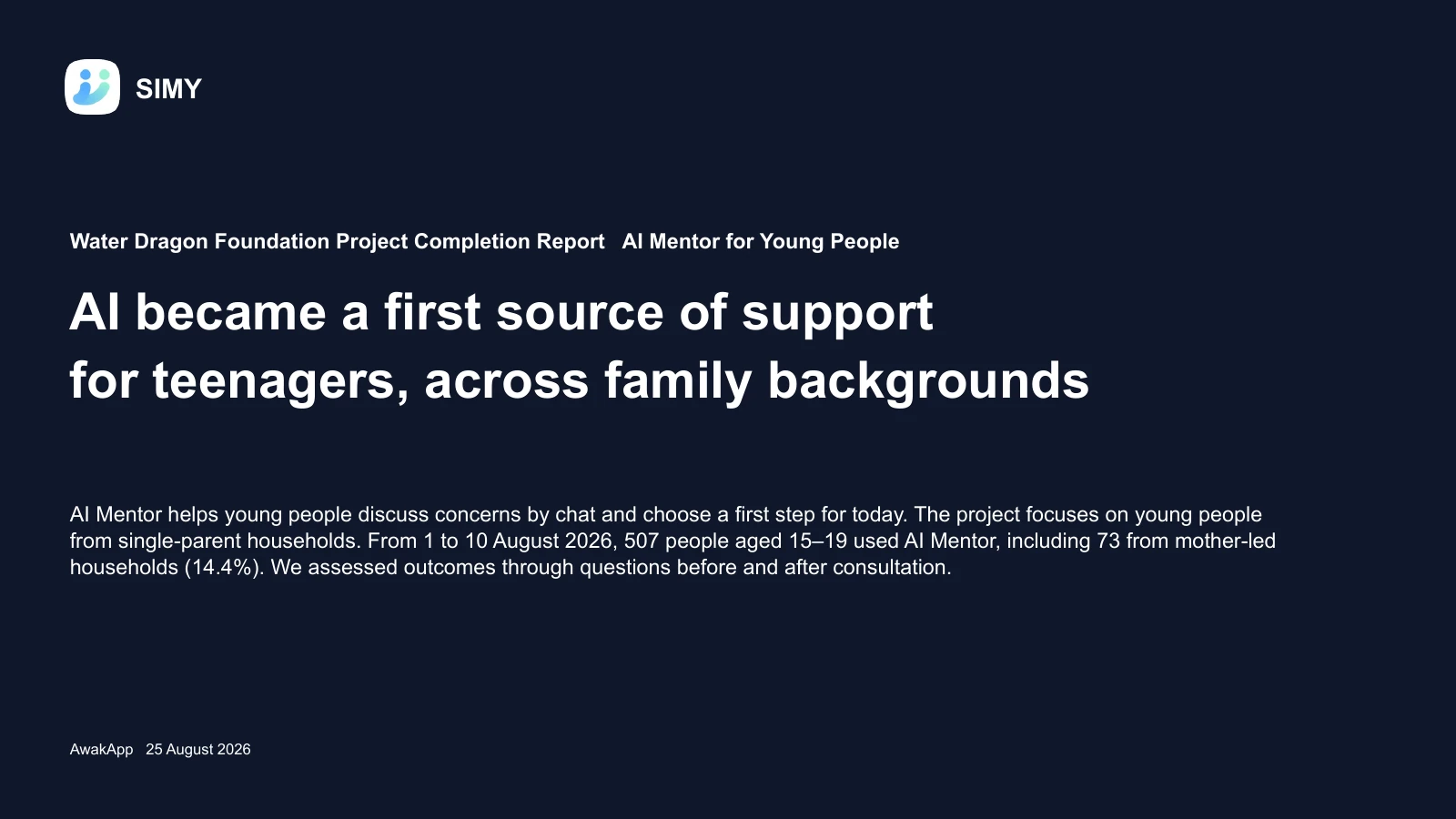
SIMY Water Dragon Foundation Project Completion Report AI Mentor for Young People AI became a first source of support for teenagers, across family backgrounds AI Mentor helps young people discuss concerns by chat and choose a first step for today. The project focuses on young people from single-parent households. From 1 to 10 August 2026, 507 people aged 15–19 used AI Mentor, including 73 from mother-led households (14.4%). We assessed outcomes through questions before and after consultation. AwakApp 25 August 2026
02 / 30

507 users followed one consultation flow

Enlarge ↗
Read slide 2 as text
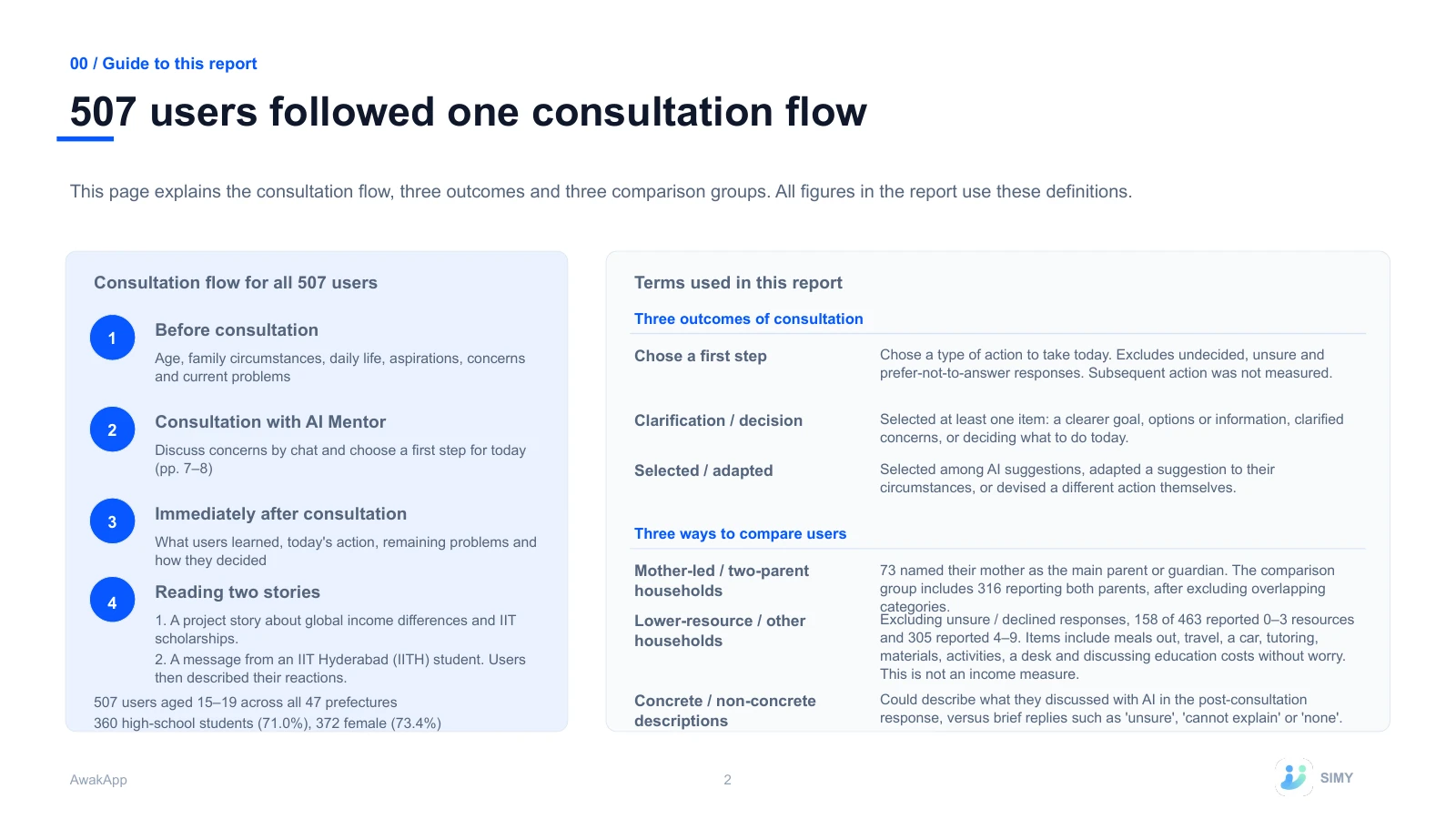
00 / Guide to this report 507 users followed one consultation flow This page explains the consultation flow, three outcomes and three comparison groups. All figures in the report use these definitions. AwakApp 2 SIMY Consultation flow for all 507 users 1 Before consultation Age, family circumstances, daily life, aspirations, concerns and current problems 2 Consultation with AI Mentor Discuss concerns by chat and choose a first step for today (pp. 7–8) 3 Immediately after consultation What users learned, today's action, remaining problems and how they decided 4 Reading two stories 1. A project story about global income differences and IIT scholarships. 2. A message from an IIT Hyderabad (IITH) student. Users then described their reactions. 507 users aged 15–19 across all 47 prefectures 360 high-school students (71.0%), 372 female (73.4%) Terms used in this report Chose a first step Chose a type of action to take today. Excludes undecided, unsure and prefer-not-to-answer responses. Subsequent action was not measured. Clarification / decision Selected at least one item: a clearer goal, options or information, clarified concerns, or deciding what to do today. Selected / adapted Selected among AI suggestions, adapted a suggestion to their circumstances, or devised a different action themselves. Mother-led / two-parent households 73 named their mother as the main parent or guardian. The comparison group includes 316 reporting both parents, after excluding overlapping categories. Lower-resource / other households Excluding unsure / declined responses, 158 of 463 reported 0–3 resources and 305 reported 4–9. Items include meals out, travel, a car, tutoring, materials, activities, a desk and discussing education costs without worry. This is not an income measure. Concrete / non-concrete descriptions Could describe what they discussed with AI in the post-consultation response, versus brief replies such as 'unsure', 'cannot explain' or 'none'. Three outcomes of consultation Three ways to compare users
03 / 30

507 users reached, 67.5% chose a first step

Enlarge ↗
Read slide 3 as text
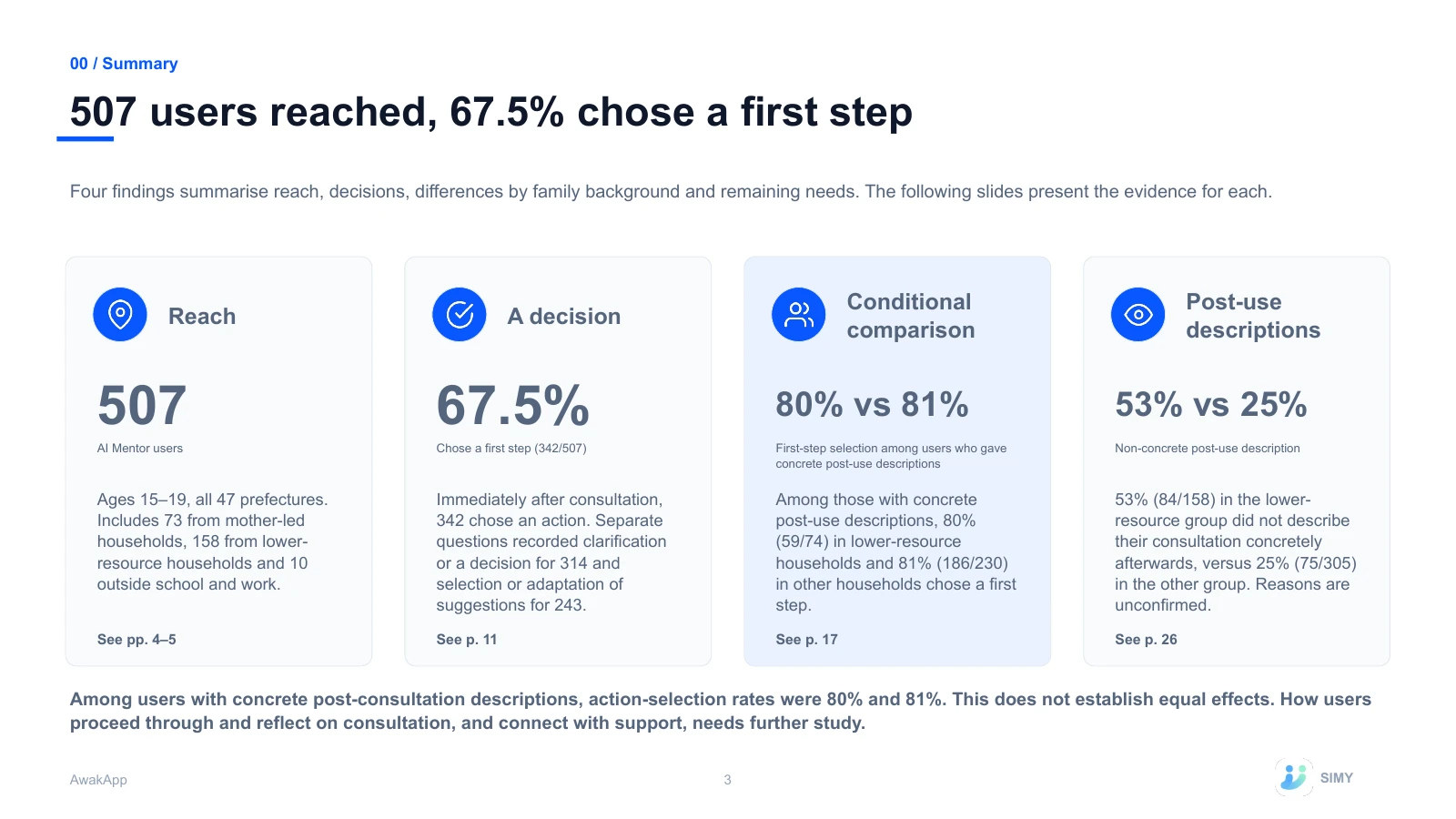
00 / Summary 507 users reached, 67.5% chose a first step Four findings summarise reach, decisions, differences by family background and remaining needs. The following slides present the evidence for each. AwakApp 3 SIMY Reach 507 AI Mentor users Ages 15–19, all 47 prefectures. Includes 73 from mother-led households, 158 from lower-resource households and 10 outside school and work. See pp. 4–5 A decision 67.5% Chose a first step (342/507) Immediately after consultation, 342 chose an action. Separate questions recorded clarification or a decision for 314 and selection or adaptation of suggestions for 243. See p. 11 Conditional comparison 80% vs 81% First-step selection among users who gave concrete post-use descriptions Among those with concrete post-use descriptions, 80% (59/74) in lower-resource households and 81% (186/230) in other households chose a first step. See p. 17 Post-use descriptions 53% vs 25% Non-concrete post-use description 53% (84/158) in the lower-resource group did not describe their consultation concretely afterwards, versus 25% (75/305) in the other group. Reasons are unconfirmed. See p. 26 Among users with concrete post-consultation descriptions, action-selection rates were 80% and 81%. This does not establish equal effects. How users proceed through and reflect on consultation, and connect with support, needs further study.
04 / 30

AI Mentor users aged 15–19 across all 47 prefectures

Enlarge ↗
Read slide 4 as text
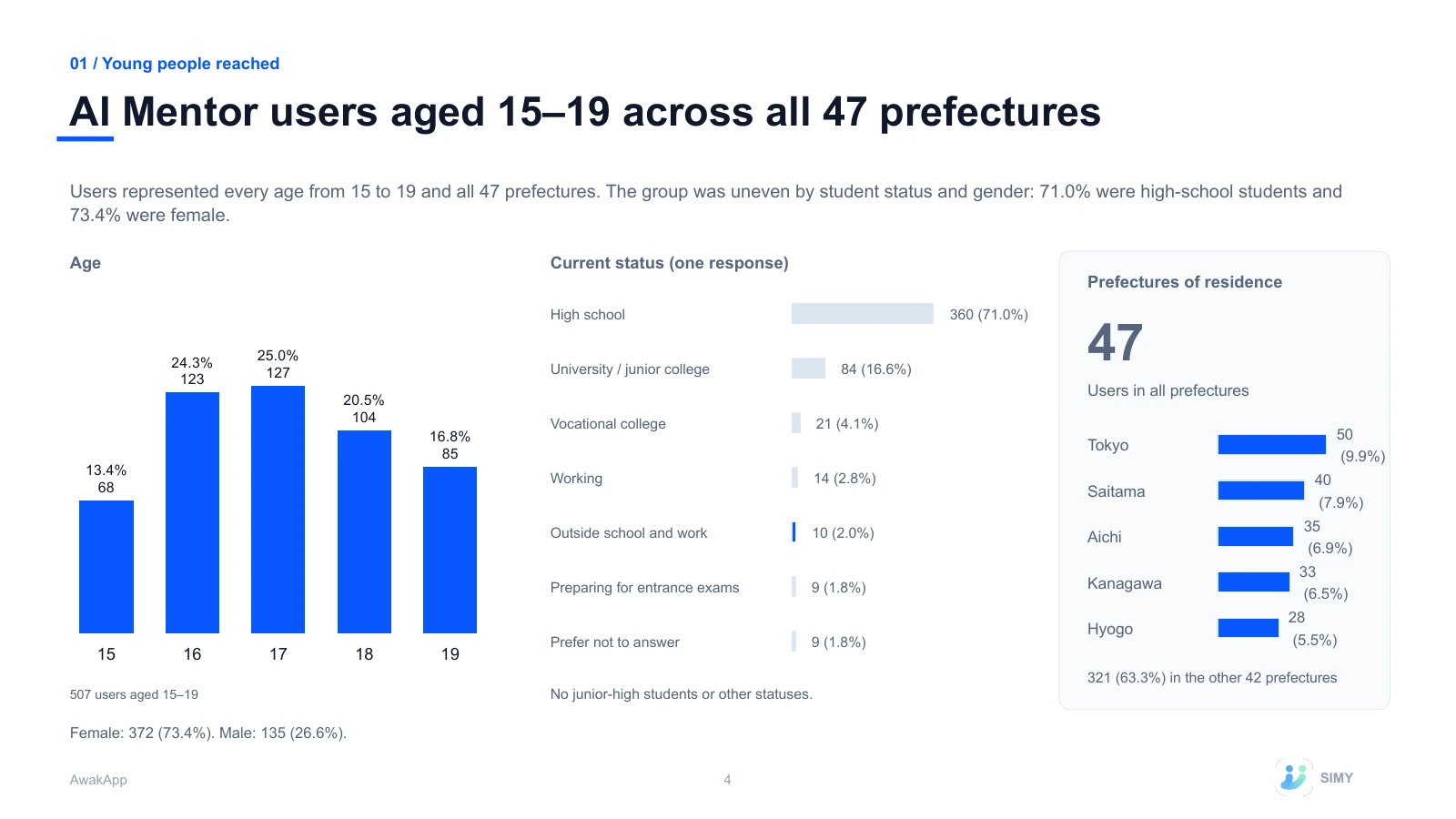
01 / Young people reached AI Mentor users aged 15–19 across all 47 prefectures Users represented every age from 15 to 19 and all 47 prefectures. The group was uneven by student status and gender: 71.0% were high-school students and 73.4% were female. AwakApp 4 SIMY Age 507 users aged 15–19 Current status (one response) High school 360 (71.0%) University / junior college 84 (16.6%) Vocational college 21 (4.1%) Working 14 (2.8%) Outside school and work 10 (2.0%) Preparing for entrance exams 9 (1.8%) Prefer not to answer 9 (1.8%) No junior-high students or other statuses. Prefectures of residence 47 Users in all prefectures Tokyo 50 (9.9%) Saitama 40 (7.9%) Aichi 35 (6.9%) Kanagawa 33 (6.5%) Hyogo 28 (5.5%) 321 (63.3%) in the other 42 prefectures Female: 372 (73.4%). Male: 135 (26.6%).
05 / 30

The same consultation reached underserved households

Enlarge ↗
Read slide 5 as text
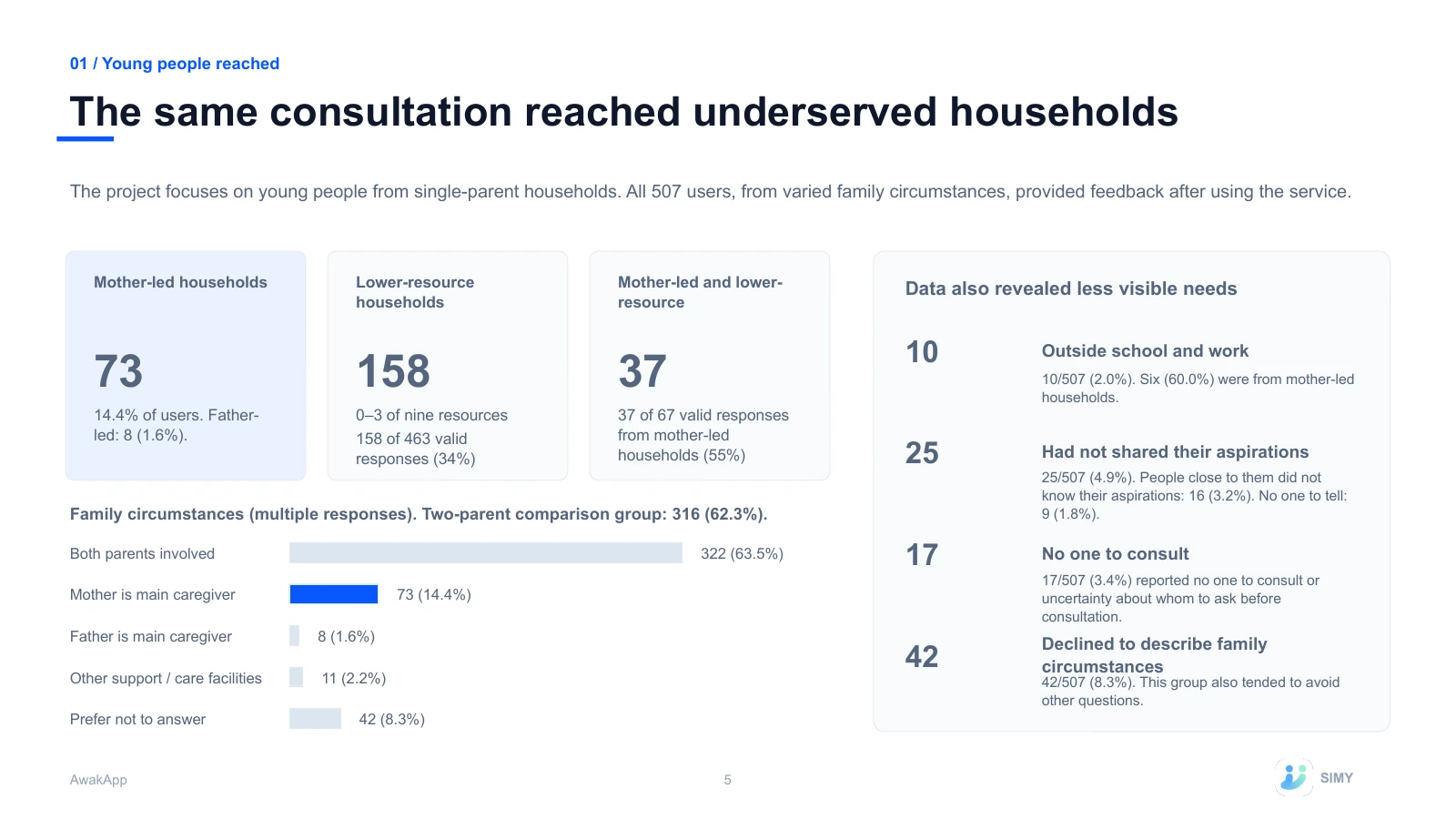
01 / Young people reached The same consultation reached underserved households The project focuses on young people from single-parent households. All 507 users, from varied family circumstances, provided feedback after using the service. AwakApp 5 SIMY Mother-led households 73 14.4% of users. Father-led: 8 (1.6%). Lower-resource households 158 0–3 of nine resources 158 of 463 valid responses (34%) Mother-led and lower-resource 37 37 of 67 valid responses from mother-led households (55%) Family circumstances (multiple responses). Two-parent comparison group: 316 (62.3%). Both parents involved 322 (63.5%) Mother is main caregiver 73 (14.4%) Father is main caregiver 8 (1.6%) Other support / care facilities 11 (2.2%) Prefer not to answer 42 (8.3%) Data also revealed less visible needs 10 Outside school and work 10/507 (2.0%). Six (60.0%) were from mother-led households. 25 Had not shared their aspirations 25/507 (4.9%). People close to them did not know their aspirations: 16 (3.2%). No one to tell: 9 (1.8%). 17 No one to consult 17/507 (3.4%) reported no one to consult or uncertainty about whom to ask before consultation. 42 Declined to describe family circumstances 42/507 (8.3%). This group also tended to avoid other questions.
06 / 30

Resources and topics among mother-led participants

Enlarge ↗
Read slide 6 as text
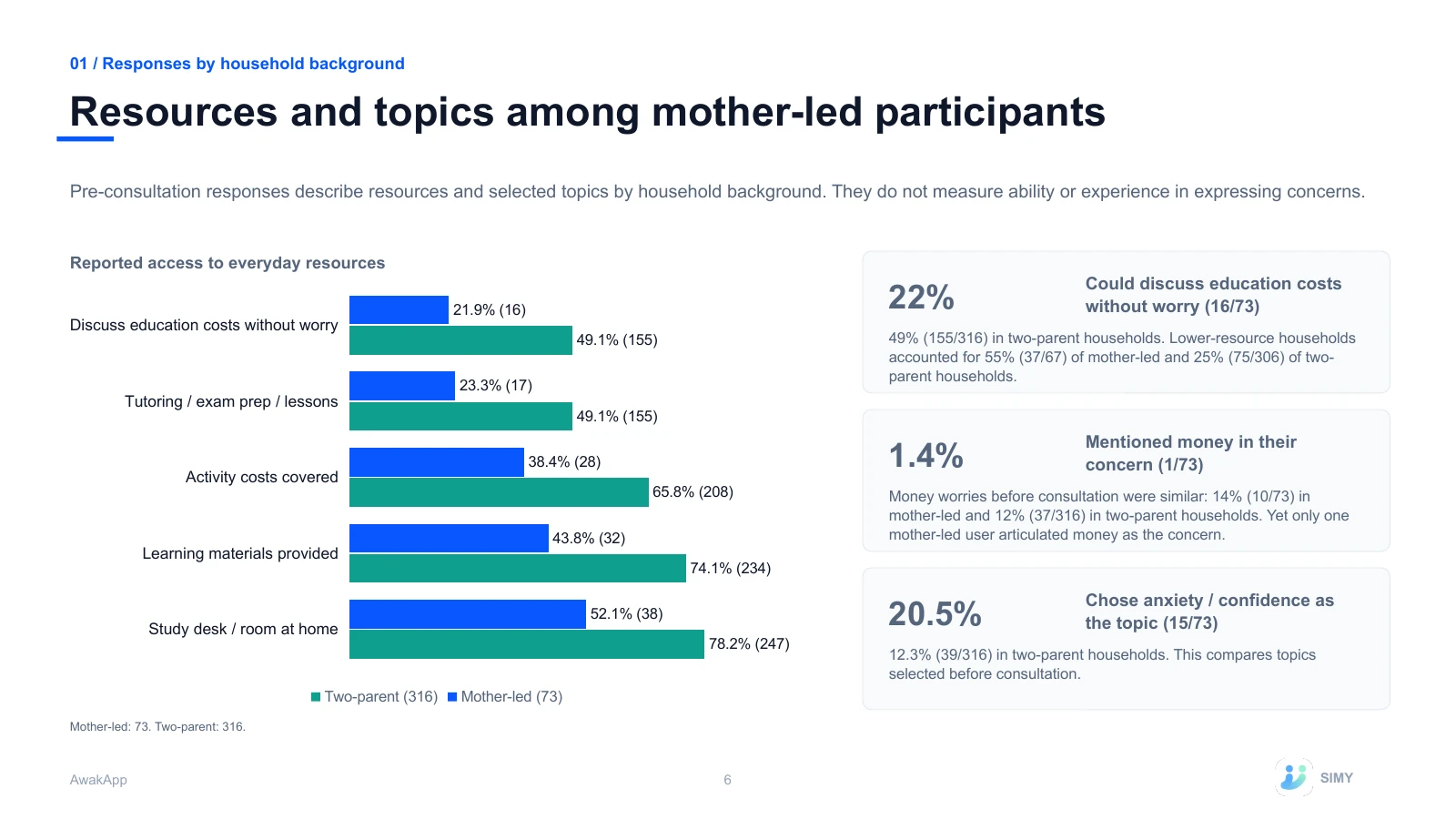
01 / Responses by household background Resources and topics among mother-led participants Pre-consultation responses describe resources and selected topics by household background. They do not measure ability or experience in expressing concerns. AwakApp 6 SIMY Reported access to everyday resources Mother-led: 73. Two-parent: 316. 22% Could discuss education costs without worry (16/73) 49% (155/316) in two-parent households. Lower-resource households accounted for 55% (37/67) of mother-led and 25% (75/306) of two-parent households. 1.4% Mentioned money in their concern (1/73) Money worries before consultation were similar: 14% (10/73) in mother-led and 12% (37/316) in two-parent households. Yet only one mother-led user articulated money as the concern. 20.5% Chose anxiety / confidence as the topic (15/73) 12.3% (39/316) in two-parent households. This compares topics selected before consultation.
07 / 30

AI Mentor turns two chosen perspectives into a plan

Enlarge ↗
Read slide 7 as text
01 / What we delivered AI Mentor turns two chosen perspectives into a plan This example recreates actual consultation output. AI presents eight perspectives around the user's goal. The user chooses two priorities, and AI develops a plan in three phases before the entrance exam. AwakApp 7 SIMY 1 Selected Gap to the passing score 2 Weak subjects 3 Using mock exams 4 Past exam practice 5 Selected A daily routine 6 Daily rhythm 7 Friends to study with 8 Someone to consult The central goal Keep studying until next spring to improve from a D rating and earn the scores needed for University X AI advice: Identify how many more points you need, then make closing that gap a daily habit. Focus on subject scores, beyond the overall D rating. Three phases proposed by AI 1 Now to September: establish a baseline Goal: Know which subjects need improvement and set a daily start time. Try: Review your latest mock exam by subject. List scores and missed topics. Set one reliable weekday study session, such as 30 minutes after getting home. Progress: Name 3–5 weak subjects or topics and start at the agreed time about five days a week. 2 October to December: close the score gap Goal: Reduce weaknesses and solve more questions than before. Try: Record scores after each mock exam or practice session. Retry missed questions and prioritise subjects with room to improve. Progress: Solve more previously missed questions correctly and explain how your scores have changed. 3 New year to exam day: secure reliable points Goal: Work within the time limit and reliably solve the questions you should get right. Try: Practise under exam timing, review mistakes and keep your established routine. Progress: Feel comfortable with timed practice and know which topics need final review. Example based on actual output. The university name is fictional. The next page turns this plan into the first week and five minutes today.
08 / 30

The plan specifies the first week and five minutes today

Enlarge ↗
Read slide 8 as text
01 / What we delivered The plan specifies the first week and five minutes today The consultation continues with a first-week plan, easier alternatives when users struggle and named people they can ask for help. AwakApp 8 SIMY Today (5–10 minutes) Open your latest mock exam. Write each subject's score on paper or your phone. Mark subjects where you could earn more points. Tomorrow (10–30 minutes) Choose three wrong answers. Note whether each came from missing knowledge, forgetting, lack of time or misreading. This week's challenge Start with 30 minutes at the same time on five days. Decide the first subject in advance. How to check progress Count days you started at the agreed time, rather than total study hours. Keep at least three problems you learned to solve this week. What can wait this week Avoid jumping into long sessions or adding many books. First decide what to improve and establish a daily starting routine. If that feels difficult Reduce 30 minutes to 10. Start with ten English words or one maths problem, and reduce days with no study. People to ask for help Show your latest mock exam to your class teacher, careers adviser or tutor. Ask which subjects to prioritise and how many points to improve. Today's first step 'For today, five minutes writing down your mock-exam scores by subject is enough.' AI Mentor's closing sentence turns a large goal into five minutes of action today. Connecting users to people The plan names people users can ask for help. Only 3.7% (19/507) chose talking to someone as today's first step. Page 28 proposes how to strengthen this connection.
09 / 30

A stable life came first, and many were unsure what to ask

Enlarge ↗
Read slide 9 as text
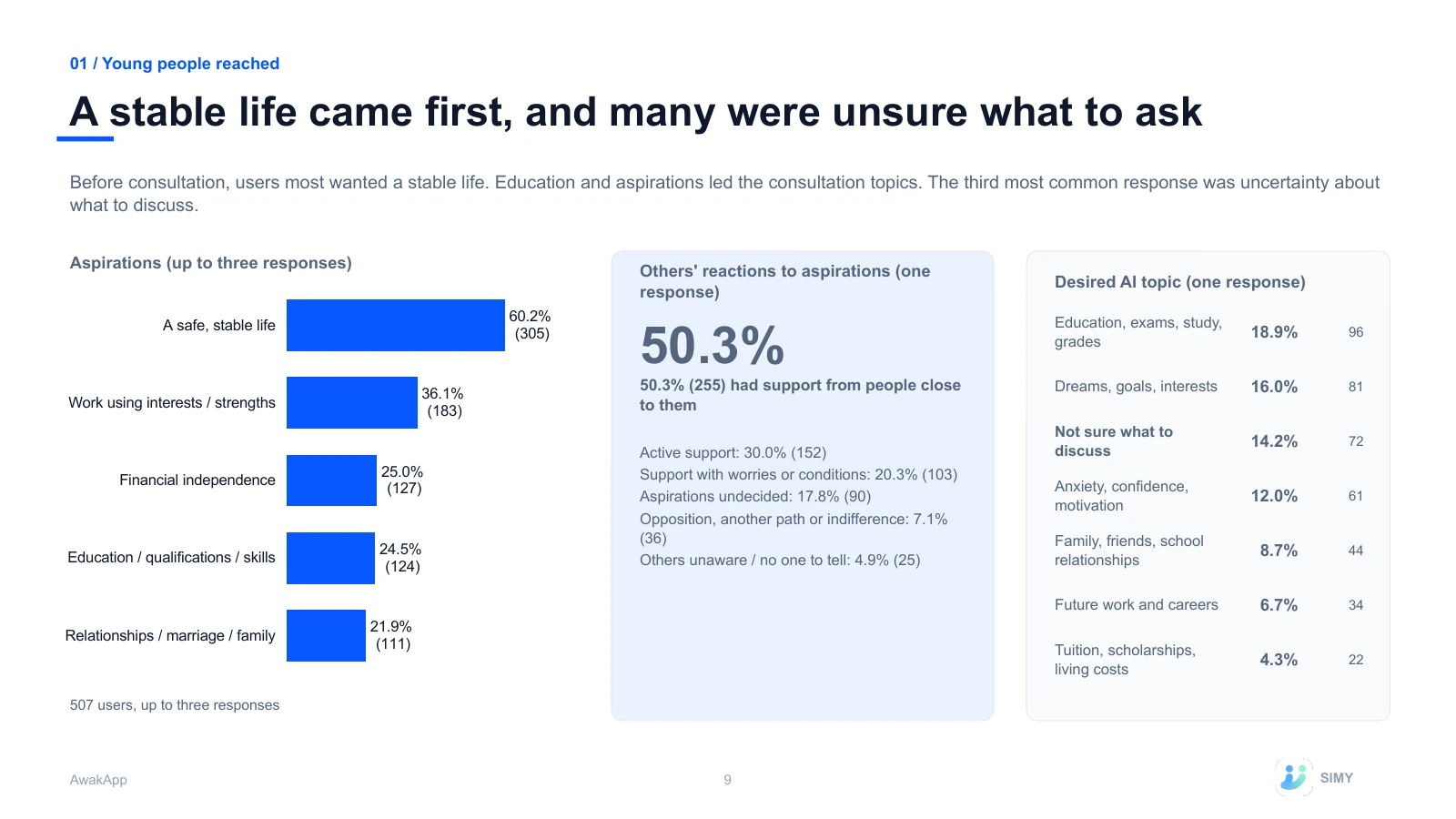
01 / Young people reached A stable life came first, and many were unsure what to ask Before consultation, users most wanted a stable life. Education and aspirations led the consultation topics. The third most common response was uncertainty about what to discuss. AwakApp 9 SIMY Aspirations (up to three responses) 507 users, up to three responses Others' reactions to aspirations (one response) 50.3% 50.3% (255) had support from people close to them Active support: 30.0% (152) Support with worries or conditions: 20.3% (103) Aspirations undecided: 17.8% (90) Opposition, another path or indifference: 7.1% (36) Others unaware / no one to tell: 4.9% (25) Desired AI topic (one response) Education, exams, study, grades 18.9% 96 Dreams, goals, interests 16.0% 81 Not sure what to discuss 14.2% 72 Anxiety, confidence, motivation 12.0% 61 Family, friends, school relationships 8.7% 44 Future work and careers 6.7% 34 Tuition, scholarships, living costs 4.3% 22
10 / 30

Difficulty describing the consultation was the largest category

Enlarge ↗
Read slide 10 as text
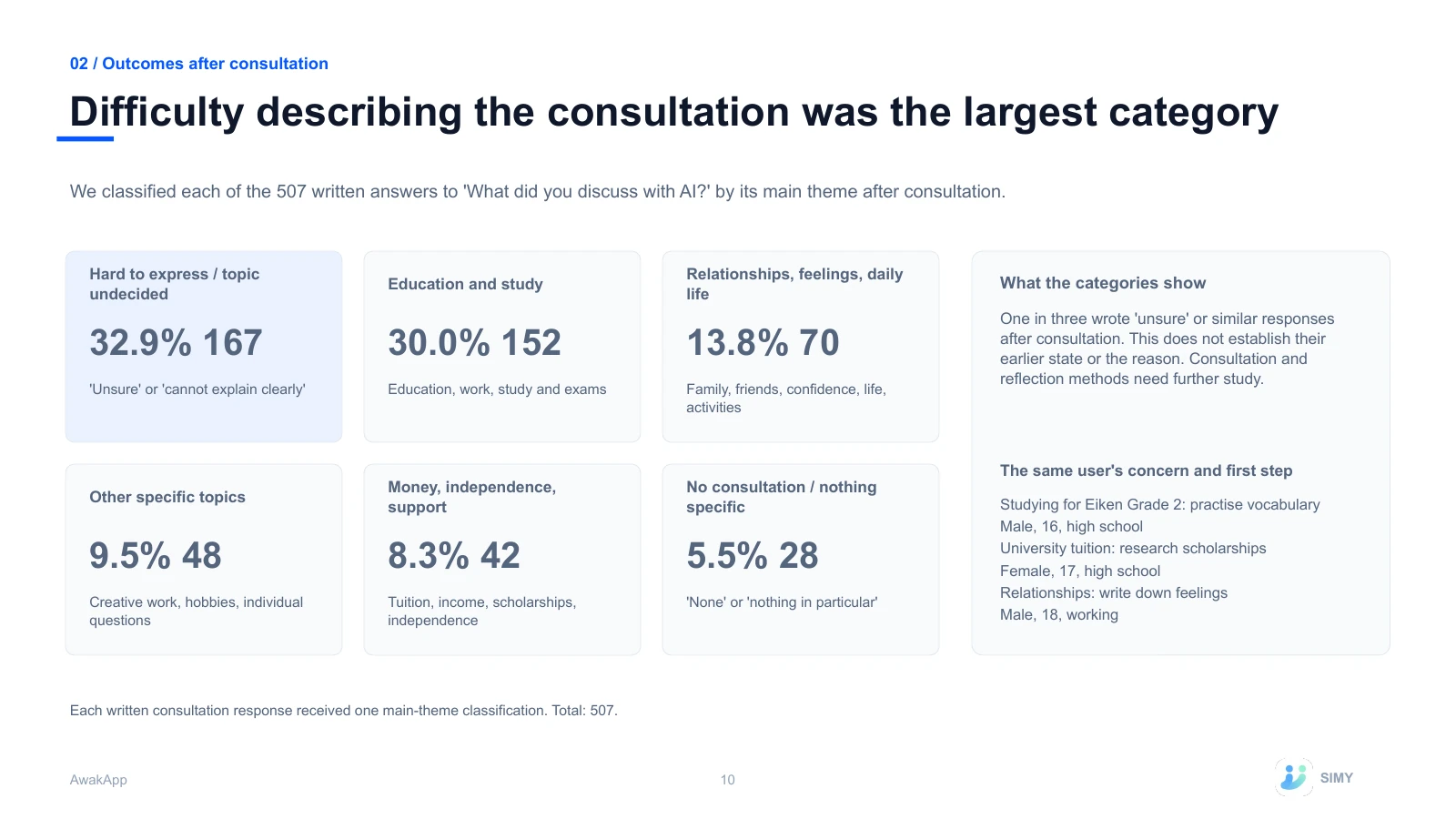
02 / Outcomes after consultation Difficulty describing the consultation was the largest category We classified each of the 507 written answers to 'What did you discuss with AI?' by its main theme after consultation. AwakApp 10 SIMY Hard to express / topic undecided 32.9% 167 'Unsure' or 'cannot explain clearly' Education and study 30.0% 152 Education, work, study and exams Relationships, feelings, daily life 13.8% 70 Family, friends, confidence, life, activities Other specific topics 9.5% 48 Creative work, hobbies, individual questions Money, independence, support 8.3% 42 Tuition, income, scholarships, independence No consultation / nothing specific 5.5% 28 'None' or 'nothing in particular' What the categories show One in three wrote 'unsure' or similar responses after consultation. This does not establish their earlier state or the reason. Consultation and reflection methods need further study. The same user's concern and first step Studying for Eiken Grade 2: practise vocabulary Male, 16, high school University tuition: research scholarships Female, 17, high school Relationships: write down feelings Male, 18, working Each written consultation response received one main-theme classification. Total: 507.
11 / 30

Two in three chose a first step immediately after use

Enlarge ↗
Read slide 11 as text
02 / Outcomes after consultation Two in three chose a first step immediately after use Three separate questions recorded action selection, clarification or a decision, and selection or adaptation of suggestions. Responses overlap. These self-reports do not establish subsequent action or causal effects. AwakApp 11 SIMY Chose a first step 67.5% 342 users chose a specific first action immediately after consultation. Clarification / decision 61.9% 314 selected at least one response covering clearer goals or options, clarified concerns, or deciding what to do today. Selected / adapted 47.9% 243 selected or adapted AI suggestions, or devised a different action themselves. The same user's concern and first step Studying for Eiken Grade 2: practise vocabulary Male, 16, high school University tuition: research scholarships Female, 17, high school Relationships: write down how I want to be Male, 18, working
12 / 30

Knowing today's action increased from 10.8% to 16.4%

Enlarge ↗
Read slide 12 as text
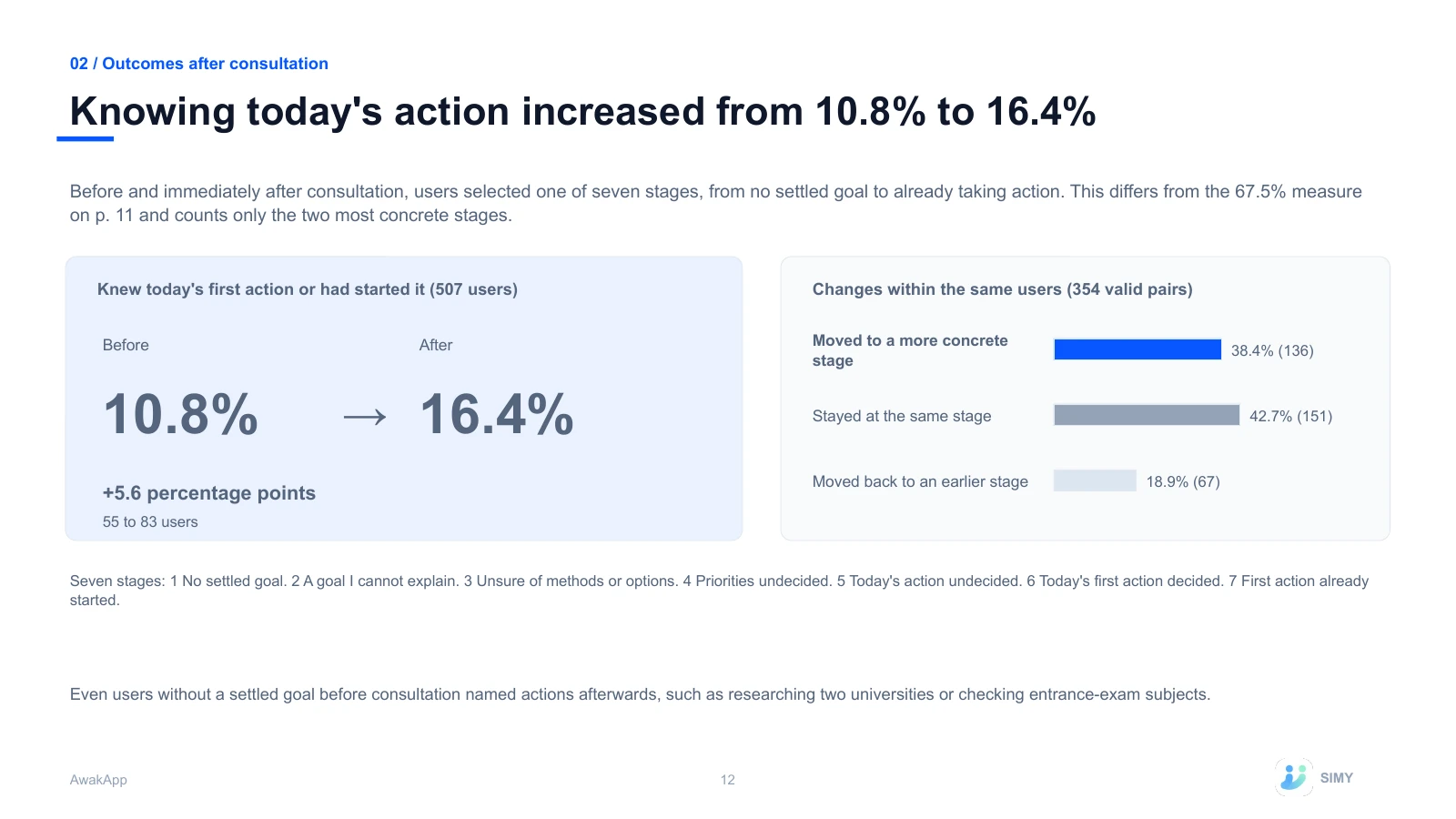
02 / Outcomes after consultation Knowing today's action increased from 10.8% to 16.4% Before and immediately after consultation, users selected one of seven stages, from no settled goal to already taking action. This differs from the 67.5% measure on p. 11 and counts only the two most concrete stages. AwakApp 12 SIMY Knew today's first action or had started it (507 users) Before 10.8% → After 16.4% +5.6 percentage points 55 to 83 users Changes within the same users (354 valid pairs) Moved to a more concrete stage 38.4% (136) Stayed at the same stage 42.7% (151) Moved back to an earlier stage 18.9% (67) Seven stages: 1 No settled goal. 2 A goal I cannot explain. 3 Unsure of methods or options. 4 Priorities undecided. 5 Today's action undecided. 6 Today's first action decided. 7 First action already started. Even users without a settled goal before consultation named actions afterwards, such as researching two universities or checking entrance-exam subjects.
13 / 30

First steps focused on study, information and daily routines

Enlarge ↗
Read slide 13 as text
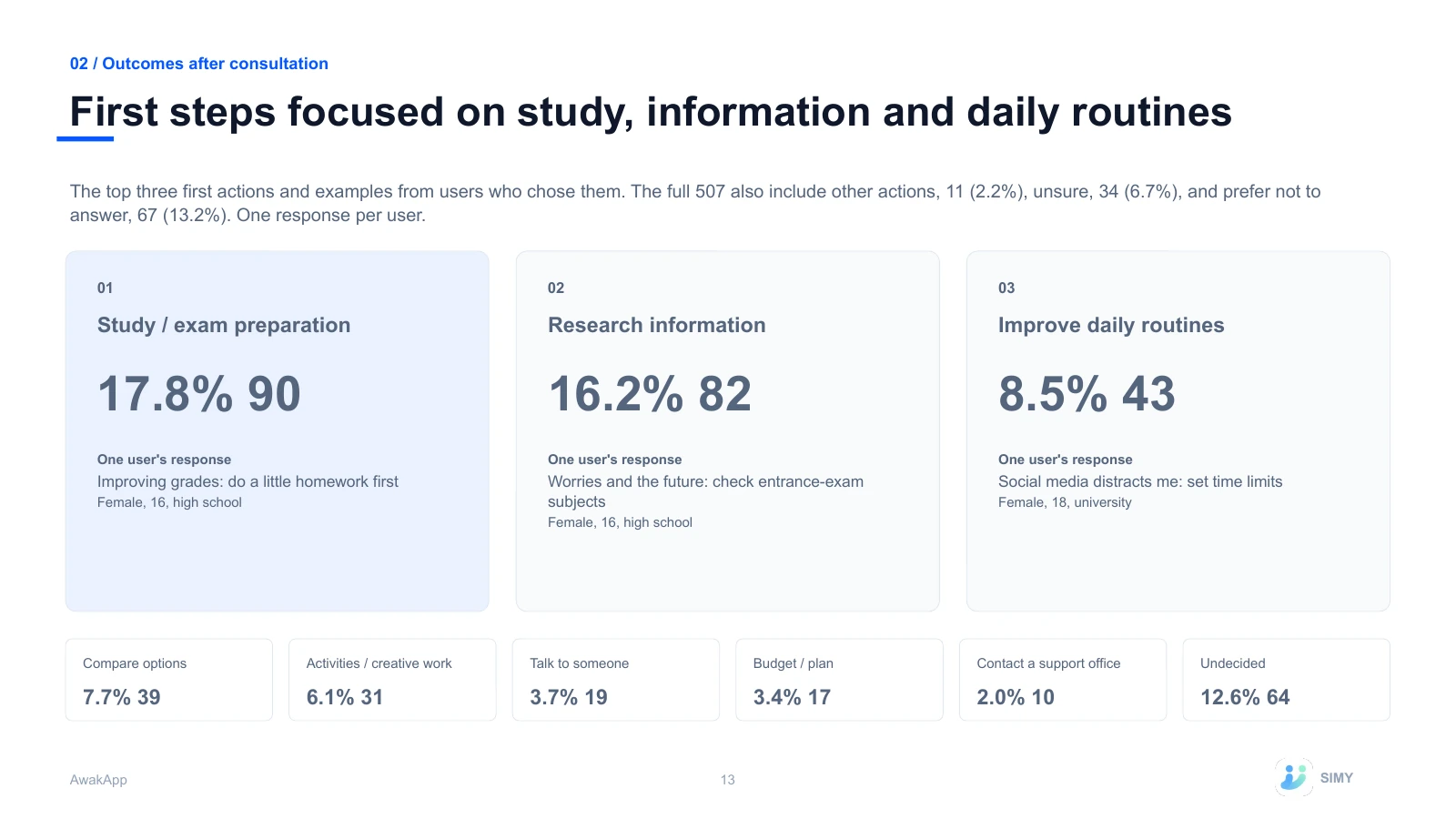
02 / Outcomes after consultation First steps focused on study, information and daily routines The top three first actions and examples from users who chose them. The full 507 also include other actions, 11 (2.2%), unsure, 34 (6.7%), and prefer not to answer, 67 (13.2%). One response per user. AwakApp 13 SIMY 01 Study / exam preparation 17.8% 90 One user's response Improving grades: do a little homework first Female, 16, high school 02 Research information 16.2% 82 One user's response Worries and the future: check entrance-exam subjects Female, 16, high school 03 Improve daily routines 8.5% 43 One user's response Social media distracts me: set time limits Female, 18, university Compare options 7.7% 39 Activities / creative work 6.1% 31 Talk to someone 3.7% 19 Budget / plan 3.4% 17 Contact a support office 2.0% 10 Undecided 12.6% 64
14 / 30

A clearer goal was the most common new insight

Enlarge ↗
Read slide 14 as text
02 / Outcomes after consultation A clearer goal was the most common new insight Users selected up to two things they learned or clarified through consultation. 61.9% selected at least one of the seven positive outcomes. AwakApp 14 SIMY What users learned or clarified (up to two) 507 users, up to two responses Clarification / decision 61.9% 314 selected at least one of the seven items. Users without improvement 11.6% (59): no particular change 1.2% (6): more uncertainty or confusion
15 / 30

Nearly half made their own choice about AI suggestions

Enlarge ↗
Read slide 15 as text
02 / Outcomes after consultation Nearly half made their own choice about AI suggestions Users chose how they decided on today's action. Selecting among suggestions, adapting one or devising a different action counts as making their own choice. AwakApp 15 SIMY How today's action was chosen (one response) Selected one of several AI suggestions 19.5% (99) Adapted a suggestion to their situation 18.3% (93) Devised a different action after the conversation 10.1% (51) Decided to follow the AI suggestion as given 12.4% (63) Chose an action already considered 7.7% (39) Did not decide a specific action for today 11.0% (56) Unsure / prefer not to answer 20.9% (106) Selected / adapted 47.9% 243 selected one of the three blue items. A question for future evaluation Future work should test how choosing an action relates to follow-through and persistence. This pilot recorded how participants decided immediately after consultation.
16 / 30

Outcomes differed by household resources across 463 users

Enlarge ↗
Read slide 16 as text
02 / Outcomes after consultation Outcomes differed by household resources across 463 users We assessed resources using nine daily-life items in the pre-consultation questions. We split 463 valid respondents by how many items applied and compared the three outcomes. AwakApp 16 SIMY Reported resources (507 users) Daily life Family meal out at least monthly 51.7% 262 Domestic travel at least yearly 30.6% 155 Overseas travel in the last three years 8.9% 45 Family car 66.7% 338 Learning environment Tutoring / exam prep / lessons 39.3% 199 Learning materials provided 60.7% 308 Activity costs covered 54.2% 275 Study desk / room 66.9% 339 Discussing education Can discuss education costs without worry 39.4% 200 Three outcomes across 463 users Counts, lower-resource / other: clarification or decision 92/218, selection or adaptation 66/173, first step 108/224. The largest gap was selection or adaptation: 56.7% minus 41.8% = 14.9 points. The next page groups participants by post-use descriptions. Classification using pre-consultation responses 1. Select items Select applicable daily-life resources 2. Count items 0–9 for each user 3. Split groups 0–3: 158 users 4–9: 305 users 4. Compare 463 Exclude 44 unsure / declined
17 / 30

Action selection was 80% and 81% among concrete descriptions

Enlarge ↗
Read slide 17 as text
02 / Outcomes after consultation Action selection was 80% and 81% among concrete descriptions This comparison selects participants by their post-consultation descriptions. Similar percentages do not establish equal effects of AI or elimination of household disparities. AwakApp 17 SIMY Chose a first step All: 158 / 305. Articulated concern: 74 / 230. Users who gave a concrete post-use description 80% vs 81% Left: lower-resource, 80% (59/74). Right: other, 81% (186/230). Clarification / decision: lower-resource, 73% (54/74), versus other, 81% (187/230). Mother-led households: idea gap narrows, action-choice gap remains Among 37 mother-led users who gave concrete post-use descriptions, 76% (28) reported clarification or a decision, versus 80% (176/220) in two-parent households. The overall 53% (39/73) versus 69% (218/316) gap narrowed to four points. First-step selection remained 70% (26) versus 81% (179/220).
18 / 30

Household comparisons differed by age group

Enlarge ↗
Read slide 18 as text
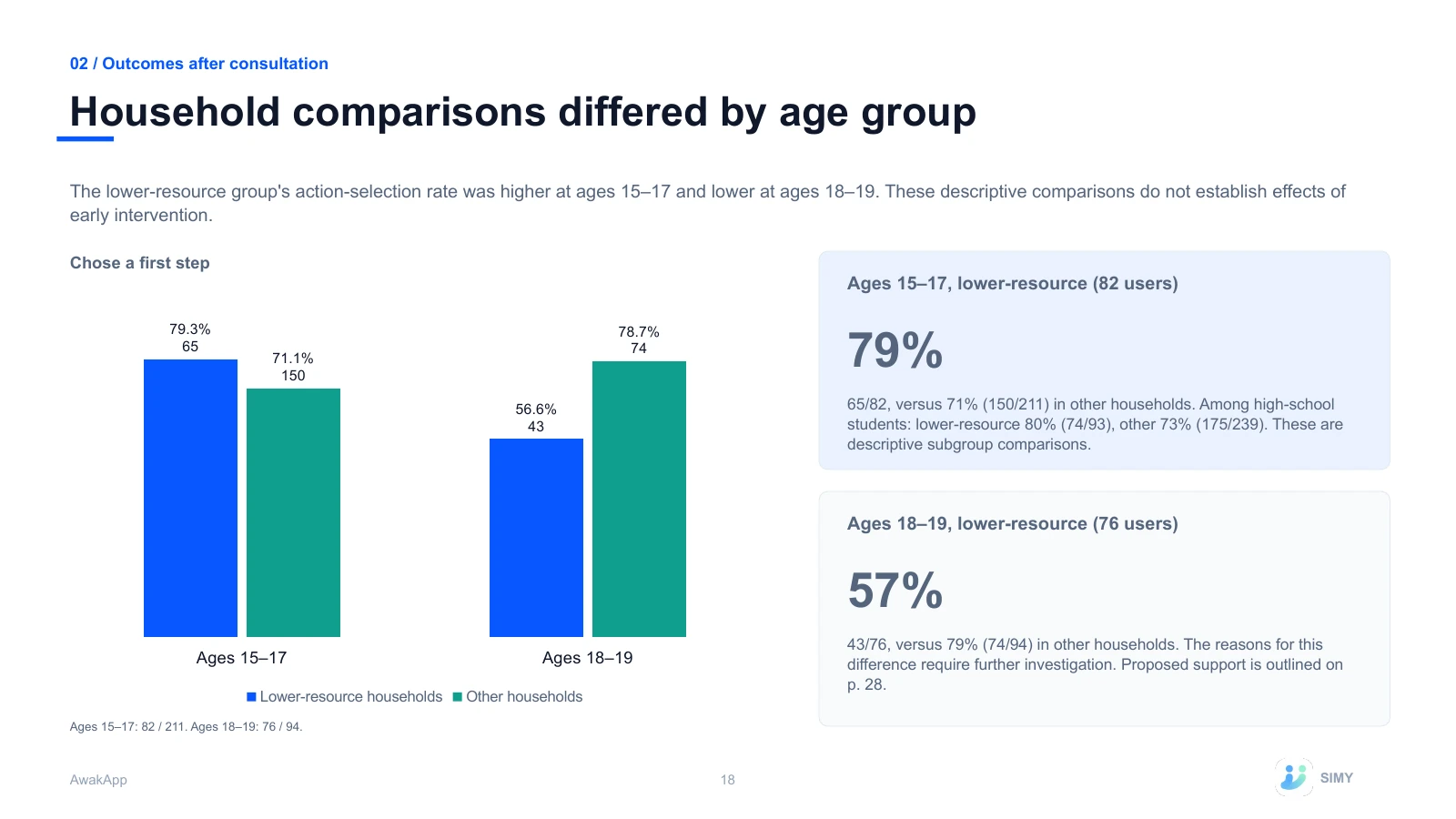
02 / Outcomes after consultation Household comparisons differed by age group The lower-resource group's action-selection rate was higher at ages 15–17 and lower at ages 18–19. These descriptive comparisons do not establish effects of early intervention. AwakApp 18 SIMY Chose a first step Ages 15–17: 82 / 211. Ages 18–19: 76 / 94. Ages 15–17, lower-resource (82 users) 79% 65/82, versus 71% (150/211) in other households. Among high-school students: lower-resource 80% (74/93), other 73% (175/239). These are descriptive subgroup comparisons. Ages 18–19, lower-resource (76 users) 57% 43/76, versus 79% (74/94) in other households. The reasons for this difference require further investigation. Proposed support is outlined on p. 28.
19 / 30

52 of 65 participants with money worries chose an action

Enlarge ↗
Read slide 19 as text
02 / Outcomes after consultation 52 of 65 participants with money worries chose an action Results for the 65 who reported money worries before consultation. This is separate from the 22 who chose money as their topic on p. 9. Their first-step selection rate exceeded the overall rate. AwakApp 19 SIMY Chose a first step 80% 52/65, versus 67.5% overall. Research, planning or contact 32% 21/65 selected research, financial planning or contacting an office. Other users: 20% (88/442). Actual use of support was not measured. Wanted to research scholarships / support 12.3% 8/65 after the two stories, versus 7.5% (38/507) overall. Concern Tuition for transferring university First step Ask the student office about scholarships Female, 19, university Concern Little money for meals. Asked about convenience stores and food choices. First step Set a budget before choosing food Female, 19, vocational college Concern How to pay my brother's tuition First step Tell him to ask his school for support Female, 17, high school 25 of the 65 who selected money worries before consultation selected it again afterwards (38.5%). This informs consideration of guidance to people and support services (p. 23).
20 / 30

17 of 73 mother-led participants chose to research information

Enlarge ↗
Read slide 20 as text
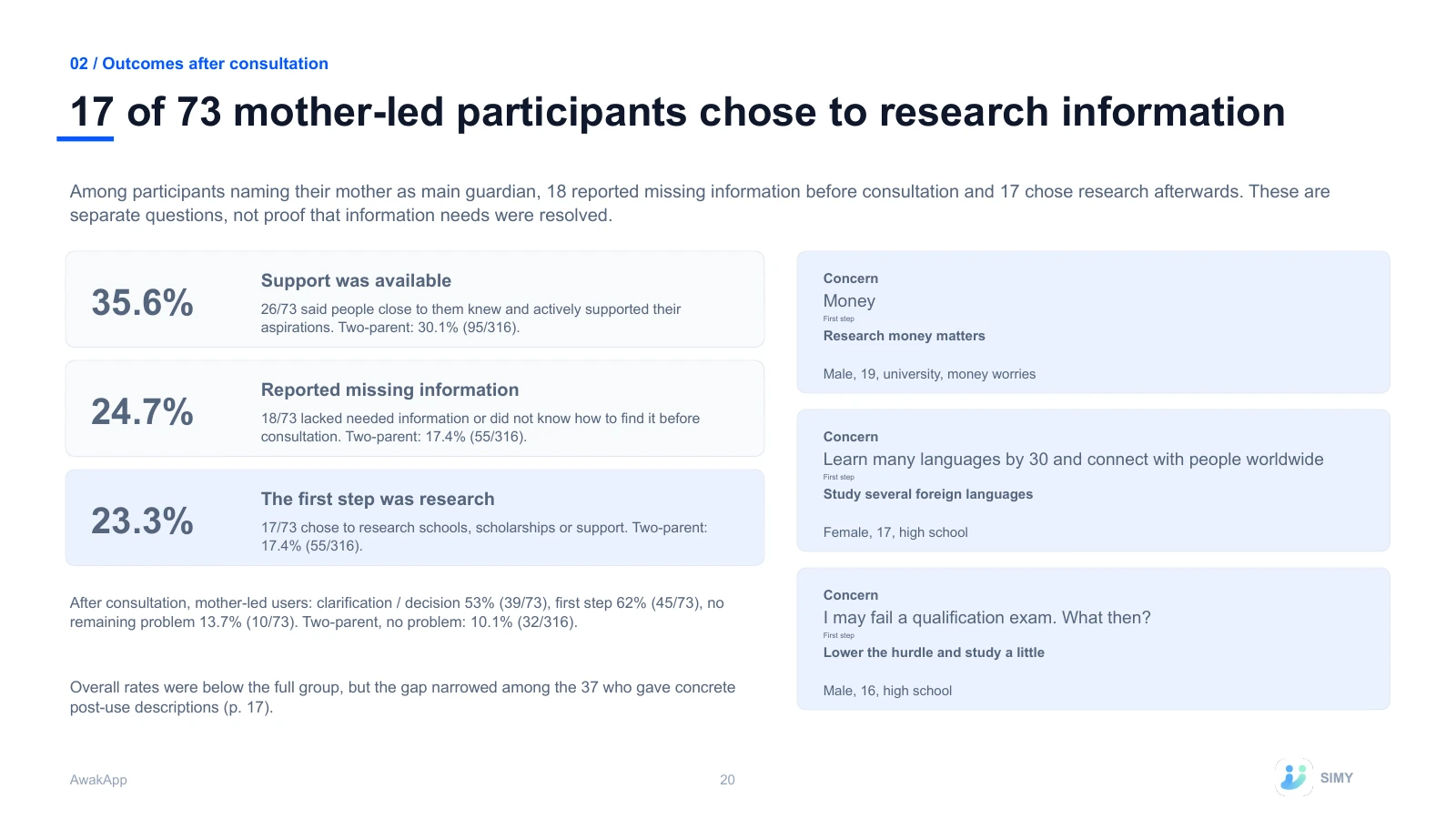
02 / Outcomes after consultation 17 of 73 mother-led participants chose to research information Among participants naming their mother as main guardian, 18 reported missing information before consultation and 17 chose research afterwards. These are separate questions, not proof that information needs were resolved. AwakApp 20 SIMY 35.6% Support was available 26/73 said people close to them knew and actively supported their aspirations. Two-parent: 30.1% (95/316). 24.7% Reported missing information 18/73 lacked needed information or did not know how to find it before consultation. Two-parent: 17.4% (55/316). 23.3% The first step was research 17/73 chose to research schools, scholarships or support. Two-parent: 17.4% (55/316). After consultation, mother-led users: clarification / decision 53% (39/73), first step 62% (45/73), no remaining problem 13.7% (10/73). Two-parent, no problem: 10.1% (32/316). Concern Money First step Research money matters Male, 19, university, money worries Concern Learn many languages by 30 and connect with people worldwide First step Study several foreign languages Female, 17, high school Concern I may fail a qualification exam. What then? First step Lower the hurdle and study a little Male, 16, high school Overall rates were below the full group, but the gap narrowed among the 37 who gave concrete post-use descriptions (p. 17).
21 / 30

94 of 198 with non-concrete descriptions also chose an action

Enlarge ↗
Read slide 21 as text
02 / Outcomes after consultation 94 of 198 with non-concrete descriptions also chose an action Nearly half of participants without concrete post-consultation descriptions chose an action. These responses alone do not establish their ability to describe concerns beforehand or why their descriptions were non-concrete. AwakApp 21 SIMY Non-concrete post-use description 198 39% of 507. Replies such as 'unsure', 'cannot explain' or 'none'. → Chose a first step 94 47.5% 83 (41.9%) described today's action in their own words. Among lower-resource users who could not articulate concerns, 49/84 (58%) chose a first step. Concern Cannot explain clearly First step Book an open-campus visit Female, 18, high school, mother-led household Concern Cannot explain clearly First step Talk with family about education Female, 18, high school Concern Cannot explain clearly First step Research what I want to become Female, 19, university, mother-led household Among 72 who were unsure what to discuss before consultation 27 (37.5%) chose a first step, 21 (29.2%) reported clarification or a decision and 16 (22.2%) made their own choice about AI suggestions. Future work can examine prompts, examples and reflection methods. These responses inform possible improvements; they do not establish why descriptions were non-concrete.
22 / 30

Action selection and post-consultation descriptions

Enlarge ↗
Read slide 22 as text
02 / Outcomes after consultation Action selection and post-consultation descriptions The diagram relates post-consultation descriptions to action selection. Band widths show counts. It does not establish a sequence of stages or a causal relationship. AwakApp 22 SIMY Users Post-use description Post-use action choice AI Mentor users 507 (100%) Concrete description 309 (60.9%) Non-concrete description 198 (39.1%) Chose a first step 342 (67.5%) Undecided / unsure / declined 165 (32.5%) 80.3% of those who could articulate 248 users 47.5% of those who could not 94 users 19.7% 61 52.5% 104 80.3% (248/309) with concrete descriptions and 47.5% (94/198) without them chose an action. Description and action selection are associated; causes are unconfirmed.
23 / 30

Fewer selected anxiety or ability concerns after consultation

Enlarge ↗
Read slide 23 as text
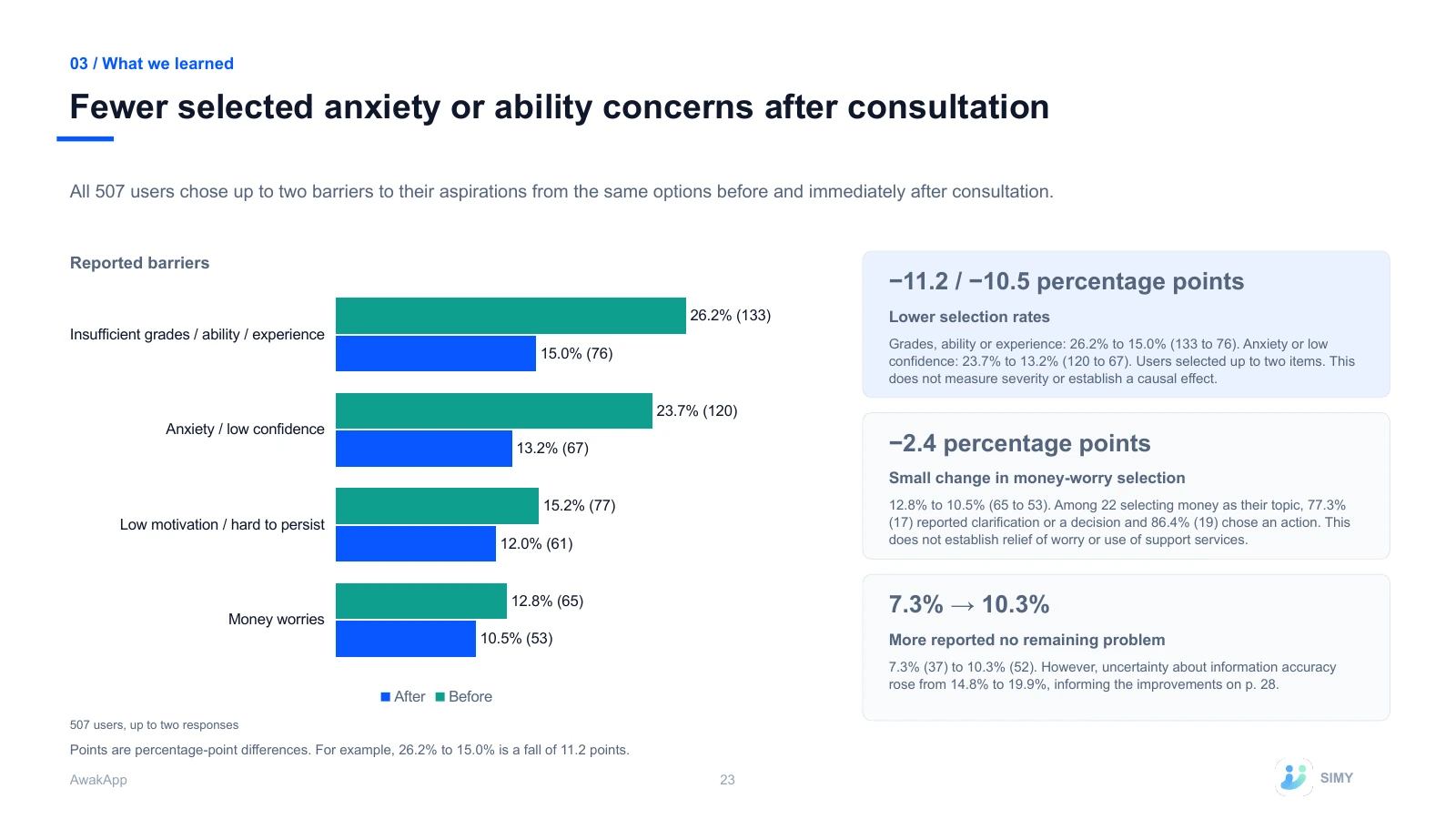
03 / What we learned Fewer selected anxiety or ability concerns after consultation All 507 users chose up to two barriers to their aspirations from the same options before and immediately after consultation. AwakApp 23 SIMY Reported barriers 507 users, up to two responses −11.2 / −10.5 percentage points Lower selection rates Grades, ability or experience: 26.2% to 15.0% (133 to 76). Anxiety or low confidence: 23.7% to 13.2% (120 to 67). Users selected up to two items. This does not measure severity or establish a causal effect. −2.4 percentage points Small change in money-worry selection 12.8% to 10.5% (65 to 53). Among 22 selecting money as their topic, 77.3% (17) reported clarification or a decision and 86.4% (19) chose an action. This does not establish relief of worry or use of support services. 7.3% → 10.3% More reported no remaining problem 7.3% (37) to 10.3% (52). However, uncertainty about information accuracy rose from 14.8% to 19.9%, informing the improvements on p. 28. Points are percentage-point differences. For example, 26.2% to 15.0% is a fall of 11.2 points.
24 / 30

37.1% responded positively to the global scholarship story

Enlarge ↗
Read slide 24 as text
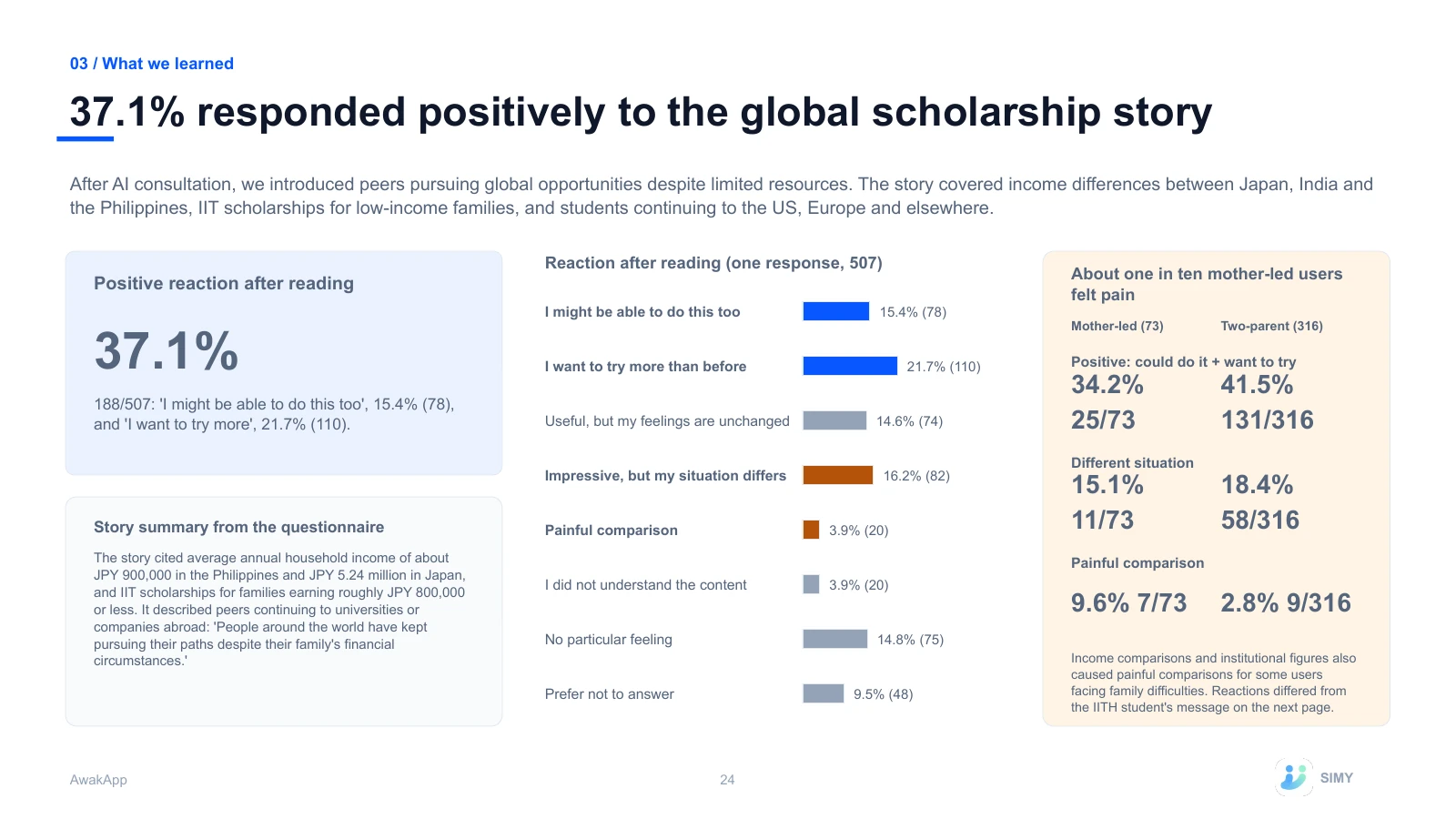
03 / What we learned 37.1% responded positively to the global scholarship story After AI consultation, we introduced peers pursuing global opportunities despite limited resources. The story covered income differences between Japan, India and the Philippines, IIT scholarships for low-income families, and students continuing to the US, Europe and elsewhere. AwakApp 24 SIMY Positive reaction after reading 37.1% 188/507: 'I might be able to do this too', 15.4% (78), and 'I want to try more', 21.7% (110). Story summary from the questionnaire The story cited average annual household income of about JPY 900,000 in the Philippines and JPY 5.24 million in Japan, and IIT scholarships for families earning roughly JPY 800,000 or less. It described peers continuing to universities or companies abroad: 'People around the world have kept pursuing their paths despite their family's financial circumstances.' Reaction after reading (one response, 507) I might be able to do this too 15.4% (78) I want to try more than before 21.7% (110) Useful, but my feelings are unchanged 14.6% (74) Impressive, but my situation differs 16.2% (82) Painful comparison 3.9% (20) I did not understand the content 3.9% (20) No particular feeling 14.8% (75) Prefer not to answer 9.5% (48) About one in ten mother-led users felt pain Mother-led (73) Two-parent (316) Positive: could do it + want to try 34.2% 25/73 41.5% 131/316 Different situation 15.1% 11/73 18.4% 58/316 Painful comparison 9.6% 7/73 2.8% 9/316 Income comparisons and institutional figures also caused painful comparisons for some users facing family difficulties. Reactions differed from the IITH student's message on the next page.
25 / 30

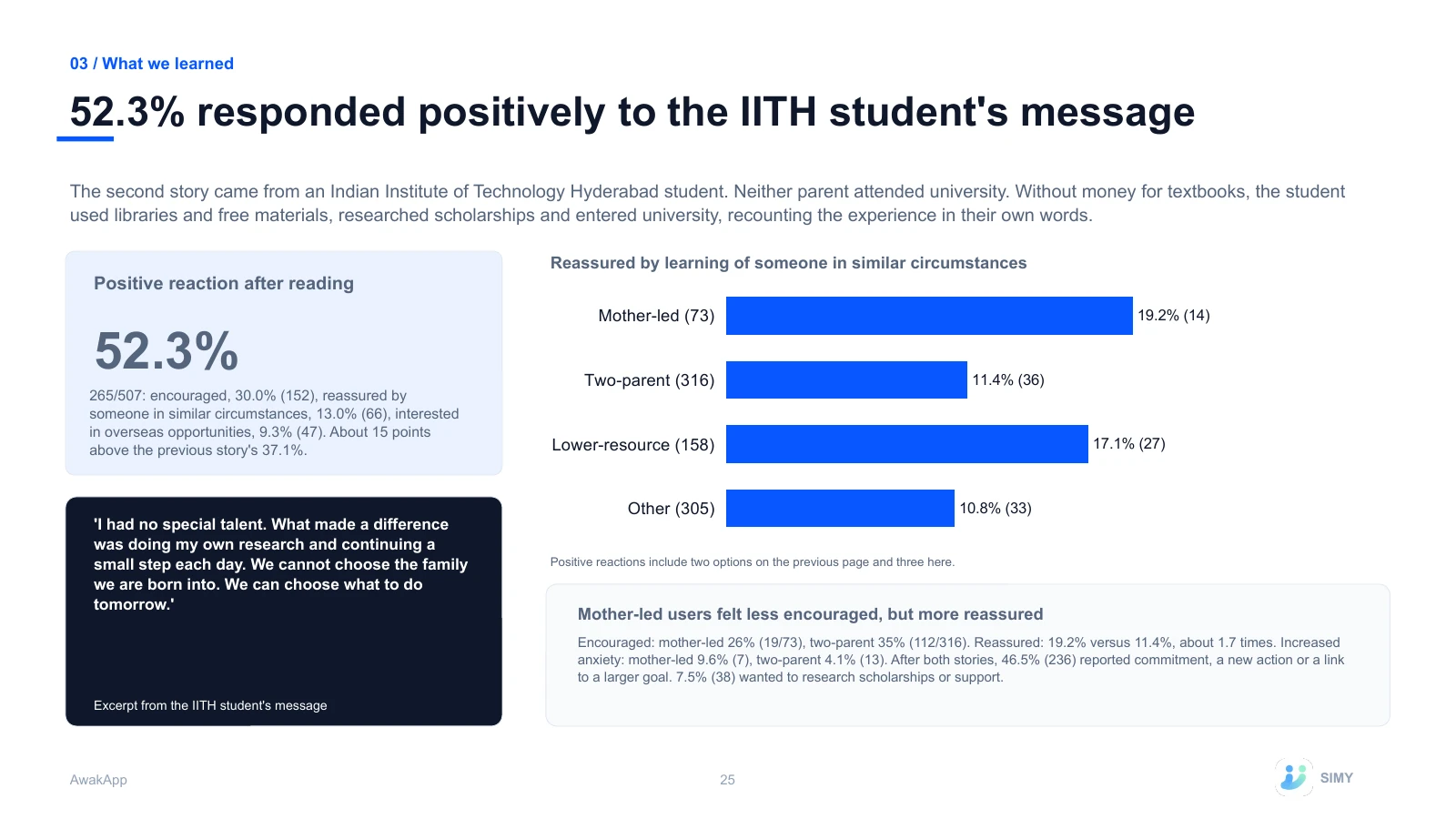
52.3% responded positively to the IITH student's message

Enlarge ↗
Read slide 25 as text
03 / What we learned 52.3% responded positively to the IITH student's message The second story came from an Indian Institute of Technology Hyderabad student. Neither parent attended university. Without money for textbooks, the student used libraries and free materials, researched scholarships and entered university, recounting the experience in their own words. AwakApp 25 SIMY Positive reaction after reading 52.3% 265/507: encouraged, 30.0% (152), reassured by someone in similar circumstances, 13.0% (66), interested in overseas opportunities, 9.3% (47). About 15 points above the previous story's 37.1%. 'I had no special talent. What made a difference was doing my own research and continuing a small step each day. We cannot choose the family we are born into. We can choose what to do tomorrow.' Excerpt from the IITH student's message Reassured by learning of someone in similar circumstances Positive reactions include two options on the previous page and three here. Mother-led users felt less encouraged, but more reassured Encouraged: mother-led 26% (19/73), two-parent 35% (112/316). Reassured: 19.2% versus 11.4%, about 1.7 times. Increased anxiety: mother-led 9.6% (7), two-parent 4.1% (13). After both stories, 46.5% (236) reported commitment, a new action or a link to a larger goal. 7.5% (38) wanted to research scholarships or support.
26 / 30

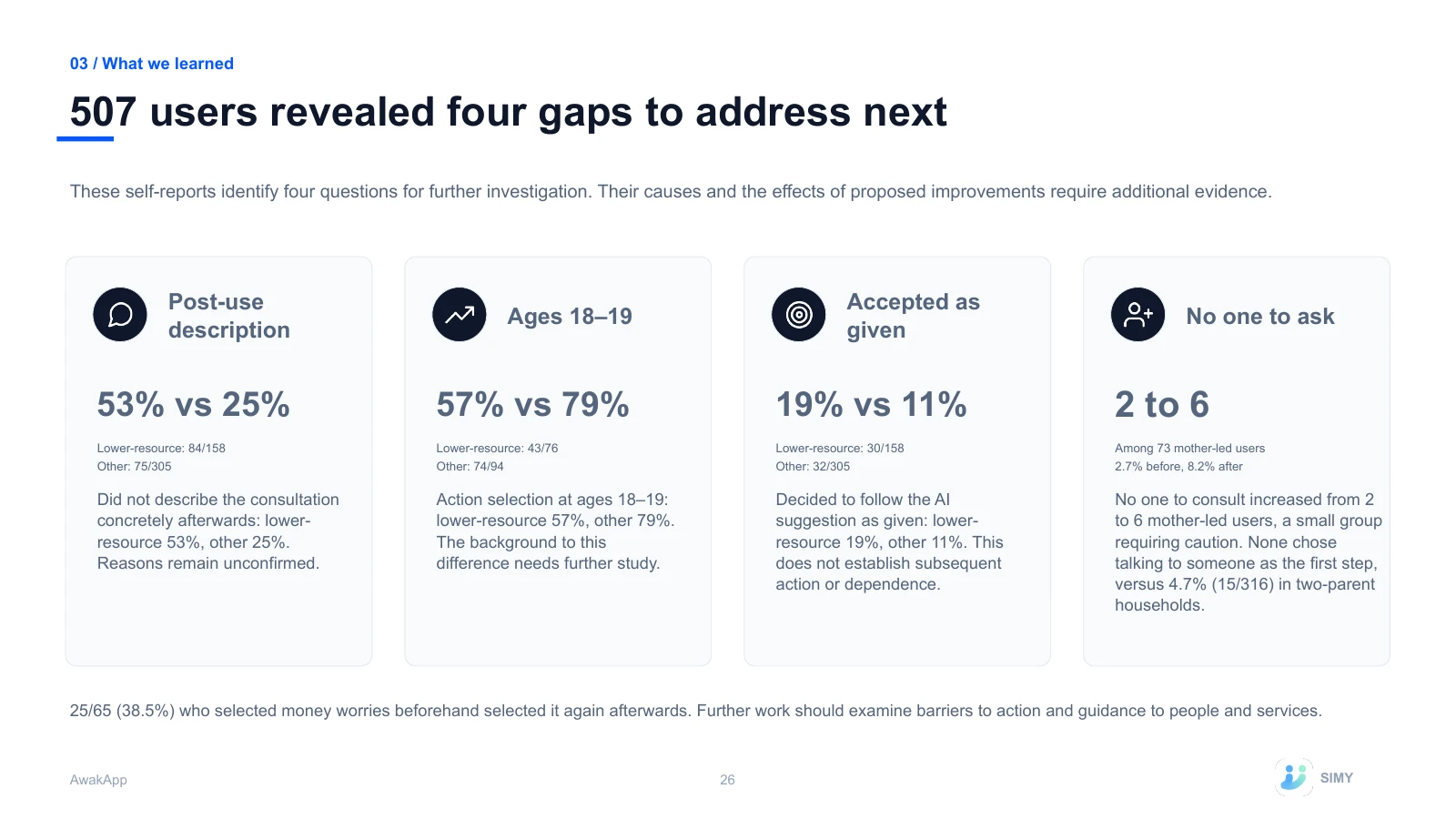
507 users revealed four gaps to address next

Enlarge ↗
Read slide 26 as text
03 / What we learned 507 users revealed four gaps to address next These self-reports identify four questions for further investigation. Their causes and the effects of proposed improvements require additional evidence. AwakApp 26 SIMY Post-use description 53% vs 25% Lower-resource: 84/158 Other: 75/305 Did not describe the consultation concretely afterwards: lower-resource 53%, other 25%. Reasons remain unconfirmed. Ages 18–19 57% vs 79% Lower-resource: 43/76 Other: 74/94 Action selection at ages 18–19: lower-resource 57%, other 79%. The background to this difference needs further study. Accepted as given 19% vs 11% Lower-resource: 30/158 Other: 32/305 Decided to follow the AI suggestion as given: lower-resource 19%, other 11%. This does not establish subsequent action or dependence. No one to ask 2 to 6 Among 73 mother-led users 2.7% before, 8.2% after No one to consult increased from 2 to 6 mother-led users, a small group requiring caution. None chose talking to someone as the first step, versus 4.7% (15/316) in two-parent households. 25/65 (38.5%) who selected money worries beforehand selected it again afterwards. Further work should examine barriers to action and guidance to people and services.
27 / 30

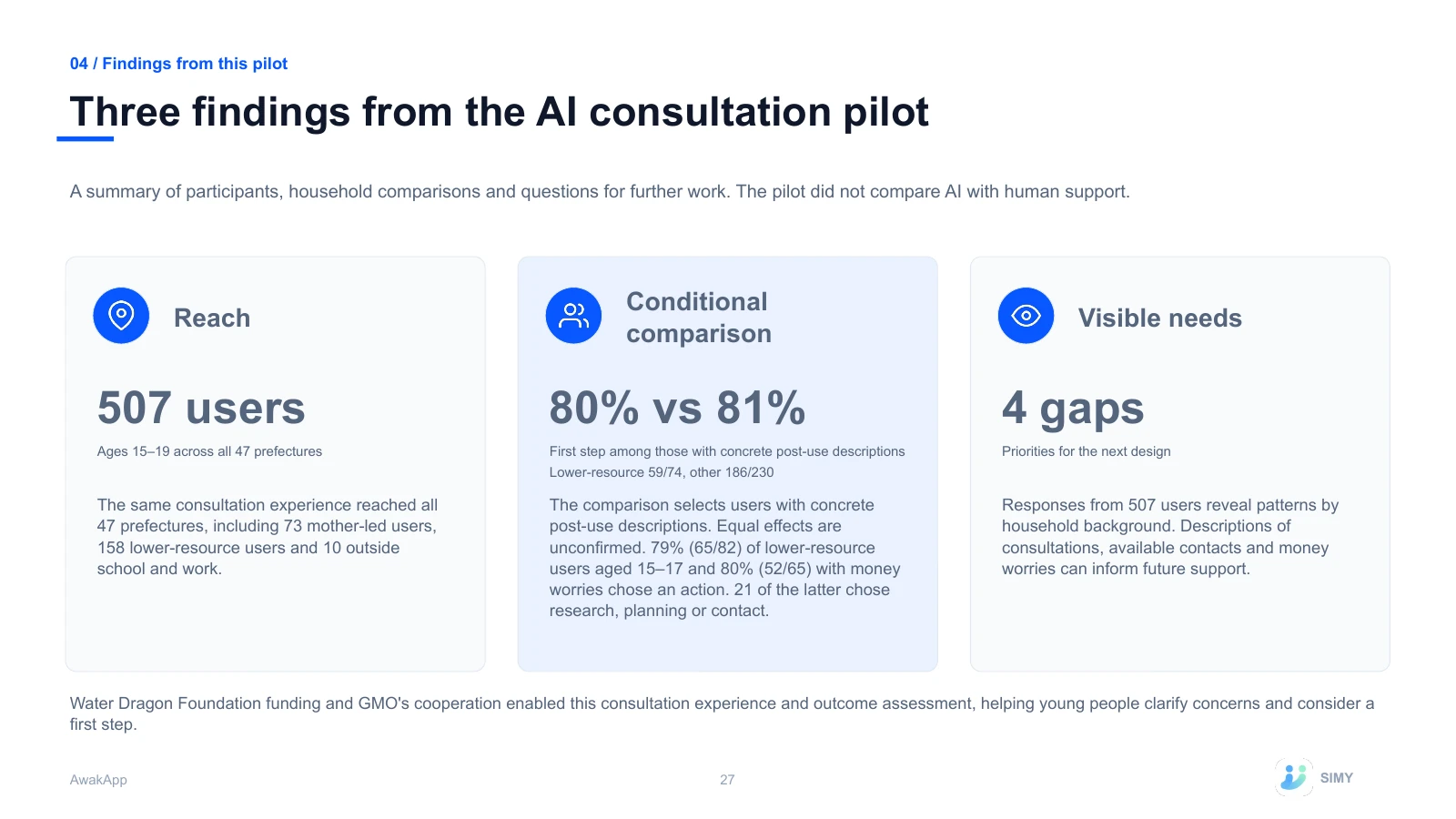
Three findings from the AI consultation pilot

Enlarge ↗
Read slide 27 as text
04 / Findings from this pilot Three findings from the AI consultation pilot A summary of participants, household comparisons and questions for further work. The pilot did not compare AI with human support. AwakApp 27 SIMY Reach 507 users Ages 15–19 across all 47 prefectures The same consultation experience reached all 47 prefectures, including 73 mother-led users, 158 lower-resource users and 10 outside school and work. Conditional comparison 80% vs 81% First step among those with concrete post-use descriptions Lower-resource 59/74, other 186/230 The comparison selects users with concrete post-use descriptions. Equal effects are unconfirmed. 79% (65/82) of lower-resource users aged 15–17 and 80% (52/65) with money worries chose an action. 21 of the latter chose research, planning or contact. Visible needs 4 gaps Priorities for the next design Responses from 507 users reveal patterns by household background. Descriptions of consultations, available contacts and money worries can inform future support. Water Dragon Foundation funding and GMO's cooperation enabled this consultation experience and outcome assessment, helping young people clarify concerns and consider a first step.
28 / 30

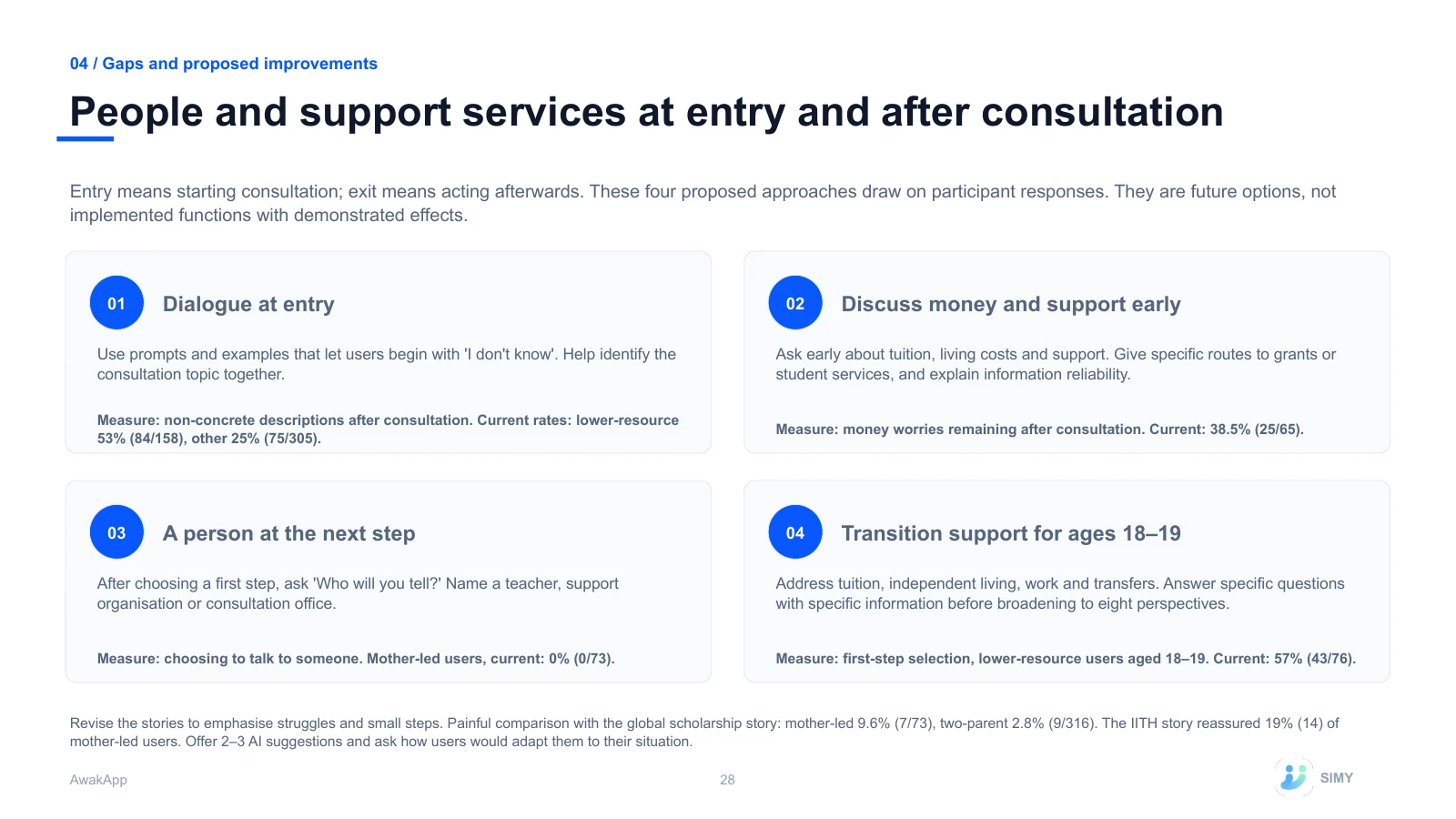
People and support services at entry and after consultation

Enlarge ↗
Read slide 28 as text
04 / Gaps and proposed improvements People and support services at entry and after consultation Entry means starting consultation; exit means acting afterwards. These four proposed approaches draw on participant responses. They are future options, not implemented functions with demonstrated effects. AwakApp 28 SIMY 01 Dialogue at entry Use prompts and examples that let users begin with 'I don't know'. Help identify the consultation topic together. Measure: non-concrete descriptions after consultation. Current rates: lower-resource 53% (84/158), other 25% (75/305). 02 Discuss money and support early Ask early about tuition, living costs and support. Give specific routes to grants or student services, and explain information reliability. Measure: money worries remaining after consultation. Current: 38.5% (25/65). 03 A person at the next step After choosing a first step, ask 'Who will you tell?' Name a teacher, support organisation or consultation office. Measure: choosing to talk to someone. Mother-led users, current: 0% (0/73). 04 Transition support for ages 18–19 Address tuition, independent living, work and transfers. Answer specific questions with specific information before broadening to eight perspectives. Measure: first-step selection, lower-resource users aged 18–19. Current: 57% (43/76). Revise the stories to emphasise struggles and small steps. Painful comparison with the global scholarship story: mother-led 9.6% (7/73), two-parent 2.8% (9/316). The IITH story reassured 19% (14) of mother-led users. Offer 2–3 AI suggestions and ask how users would adapt them to their situation.
29 / 30

Exploring support for carrying out chosen steps through SIMY

Enlarge ↗
Read slide 29 as text
04 / The next step Exploring support for carrying out chosen steps through SIMY This pilot recorded choices immediately after consultation. We will draw on AI Mentor findings when considering how SIMY could support follow-through in youth services. The following are proposed approaches. AwakApp 29 SIMY 1. Decide 67.5% Chose a first step (342/507) 342 reported choosing an action immediately after consultation. Subsequent action and persistence were not measured. See p. 11 2. Support action SIMY simy.one Explore support that specifies when to begin and whom to involve, and helps with preparation and communication. Future proposal 3. Examine agency 3 feelings I can do it. I act for myself. I contribute with others. Record what users do and examine whether they feel capable, able to choose for themselves and able to work with others. Measure through action records 4. Examine confidence Confidence Self-esteem and confidence Examine how action and persistence relate to changes in self-esteem and confidence. These relationships were not tested in this pilot. Future research question The pilot recorded action selection. Future evaluation should examine follow-through, persistence and confidence. Proposed measures include completed steps, choosing to consult someone and self-reported self-esteem.
30 / 30

AI Mentor findings and future work

Enlarge ↗
Read slide 30 as text
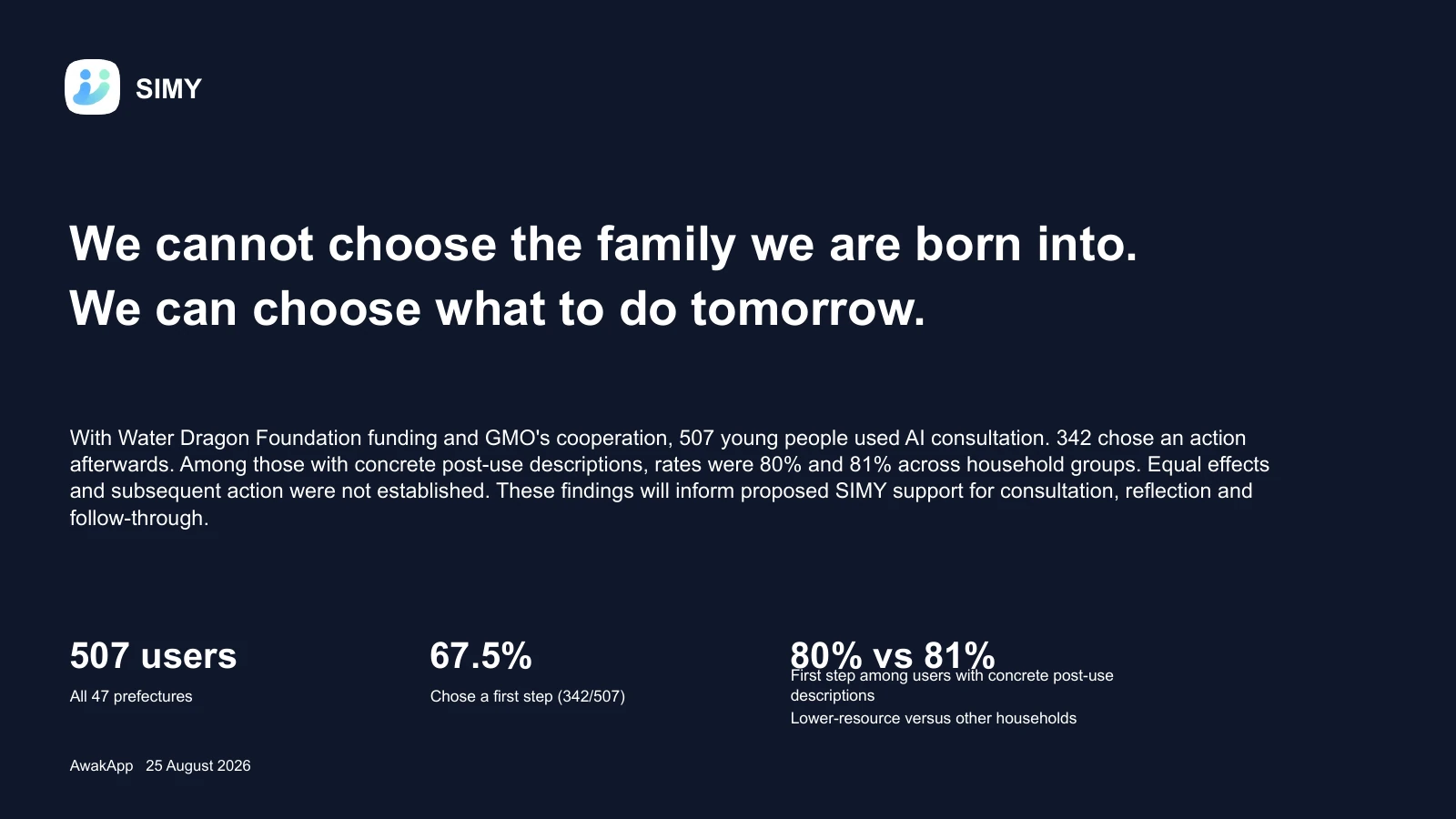
SIMY We cannot choose the family we are born into. We can choose what to do tomorrow. With Water Dragon Foundation funding and GMO's cooperation, 507 young people used AI consultation. 342 chose an action afterwards. Among those with concrete post-use descriptions, rates were 80% and 81% across household groups. Equal effects and subsequent action were not established. These findings will inform proposed SIMY support for consultation, reflection and follow-through. 507 users All 47 prefectures 67.5% Chose a first step (342/507) 80% vs 81% First step among users with concrete post-use descriptions Lower-resource versus other households AwakApp 25 August 2026

METHOD

Method and definitions

Project lead
AwakApp (General Incorporated Association)
Grant support
Water Dragon Foundation
Pilot dates
1–10 August 2026
Participants
507 people aged 15–19 across all 47 prefectures of Japan. High-school students: 71.0%. Female participants: 73.4%. The sample is not representative of all young people.
Implementation support
GMO Research & AI supported the study, which recruited people aged 15–19 across Japan, excluding junior-high-school students, to experience AI consultation and answer questionnaires.
Method
Pre-consultation questionnaire, use of AI Mentor and an immediate post-consultation questionnaire. Participants then read material introducing scholarships and related topics, plus a message from IITH students, and reported their reactions. The main outcomes above use the immediate post-consultation responses.
Household classification
Nine indicators: family meals out, domestic travel, international travel, a family car, cram school, learning materials, extracurricular costs, a study desk, and discussing education costs at home without worry. This is not an income measure or official poverty classification.
Scope
Descriptive analysis of immediate self-reports, without a control-group comparison or follow-up of action or persistence. The 342 participants selected an action category after consultation; this is not a count of people who changed from having no decided action beforehand. The results do not establish that household disparities were eliminated or that effects were equivalent across groups.
Source
Water Dragon Foundation Project Completion Report: AI Mentor, dated 25 August 2026. Wording and interpretation have been revised for publication while retaining the reported figures.

FOR MEDIA

Media inquiries and citation

AwakApp Japan LLC handles media inquiries about the methods, consultation design and household comparisons. Contact: Tetsuo Shiwaku (tetsuo@simy.one). Please credit “AwakApp (General Incorporated Association), AI Mentor project report” when citing the findings. This page provides the detailed results and report.

Contact us